FIPP’s latest Global Digital Subscription Snapshot gauges the growing influence of AI search
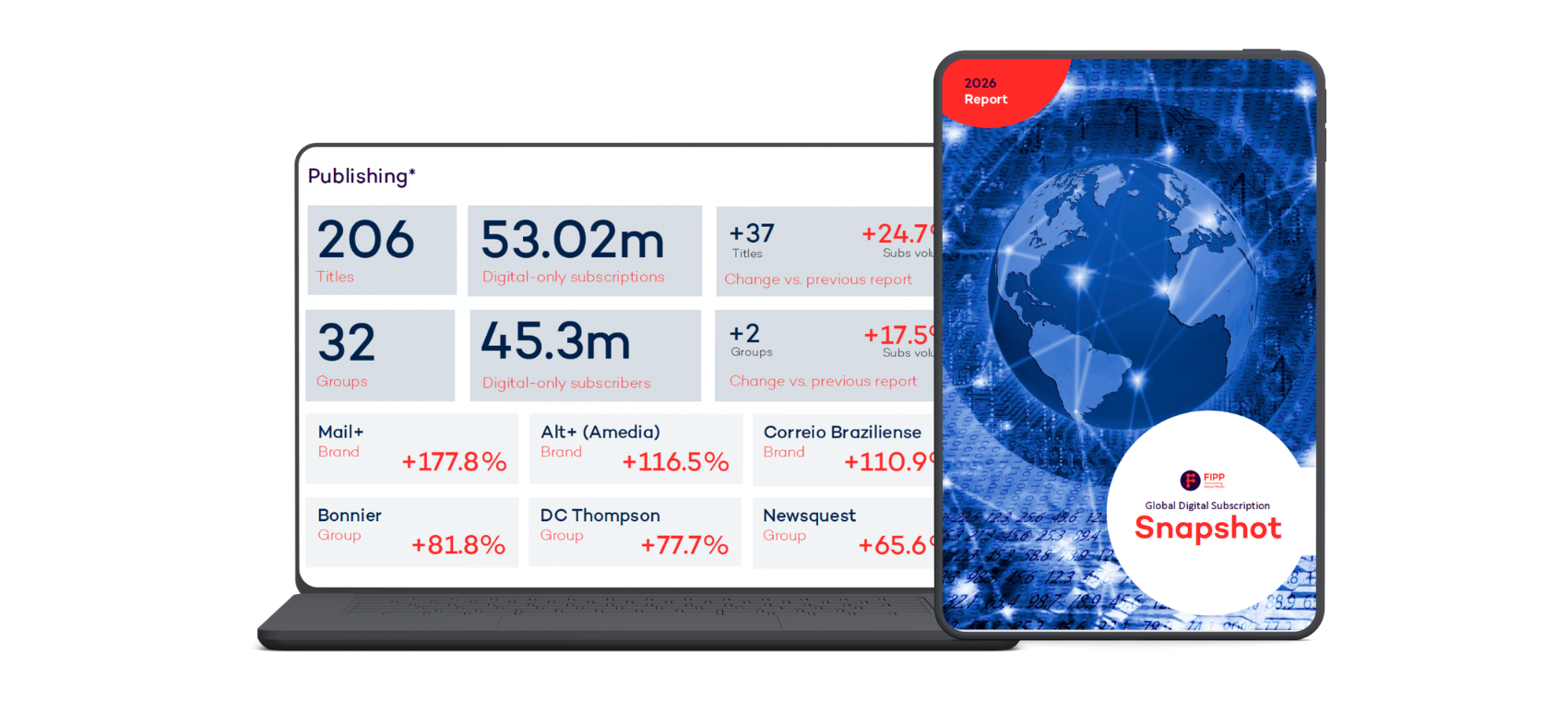
As AI search continues to reshape digital publishing strategies, the subscription market has entered a more defensive phase, FIPP’s Global Digital Subscription Snapshot 2026, launched this week, shows.
The most comprehensive report on the global digital subscriptions market today, the Snapshot, which is now released annually, features information on a huge range of individual titles as well as video streaming and music services.
The Global Digital Subscription Snapshot 2026 underlines the extent to which the rapid expansion of generative AI into search (and the way it is changing how audiences access information online) is influencing digital subscription strategies, with the response from publishers becoming clearer.
Stronger subscription businesses are increasingly built around direct audience relationships, deeper product ecosystems and broader perceived value inside paid products.
Weaker referral traffic, higher acquisition pressure and greater competition for attention has seen publishers becoming more deliberate in how they structure products, deepen engagement and reduce dependence on external distribution.
With FIPP now part of WAN-IFRA membership, all FIPP resources are moving to the Knowledge Hub. This central platform also hosts a wealth of media industry presentations, recordings, expert insights, and more.
FIPP members now gain access to the full library of WAN-IFRA content across its communities, including Distripress, Women in News, AI in Media, and others. Register in the Knowledge Hub to start exploring. Scroll down for details on how to get started.
A New York connection
As has been the case over the last few years, The New York Times Company has been the media brand to watch when it comes to negotiating shifting trends.
The company now has more than 12 million digital-only subscribers, reinforcing how subscription growth is supported more and more by multiple products bundled together to create user value, rather than leveraging the strength of a single flagship title alone.
The New York Times Company is increasingly looking outside of its own product portfolio to target growth.
While the group is known for its digital model combining journalism with other verticals products like Cooking, Wirecutter at Sport (acquiring The Athletic in 2022 to cover its sports coverage), the Snapshot finds that this bundle logic is now increasingly extending beyond the company’s own product portfolio.
Over the past year, a growing number of global publishers have introduced subscription offers that include access to The New York Times as part of their own premium products, including El País, Politiken, The Irish Times, Corriere della Sera, NRC, De Standaard, Le Monde, La Repubblica and Tempo.
It’s a clever trade-off: local publishers add international reporting from an iconic brand, while The New York Times Company extends its subscriber reach in markets where direct acquisition may be slower or more expensive.
The New York Times Company appears to be positioning itself at the centre of a new bundling phase where multiple publishers increasingly interconnect with other premium subscription propositions.
A similar ecosystem logic is at play at Substack – who has reached 5 million paying subscribers through internal recommendations that allow readers to move between newsletters inside one platform – and at local news publishers like Amedia in Norway and Bonnier News Local in Sweden that serve small markets in local vernaculars.
In the UK, The Guardian’s concerted effort to expand and monetise its global footprint is paying off nicely. The group’s most recent financial results showed revenues of £275.9 million, up £18.1 million year-on-year, while digital reader revenue rose 21.7% to £107.3 million.
And the newspaper’s brand of news clearly travels well – its strongest growth momentum came from outside the UK. International revenues increased 16.3% to £105.5 million, with the United States delivering particularly strong growth, rising 22.5% to £55.5 million.
Global audiences outside the UK now account for 60% of recurring supporters by volume, with the company steadily reducing its dependence on the UK market.
Meanwhile, several American local news publishers, including Lee Enterprises and The USA Today Co (previously Gannett), are suffering declines in their digital subscriber base as they reposition their strategies to optimise price and retention of the single title subscriptions they continue to offer.
Netflix hitting home runs
On the streaming front, the Netflix juggernaut keeps on rolling – the entertainment giant reporting an 18% increase in revenue while reaching 325,000,000 paying subscribers. It means the company now reaches an estimated global audience of one billion people.
Netflix also reported improved profitability, with advertising revenue increasing by an eye-catching 250% year-on-year to reach $1.5 billion. And the impressive momentum is set to continue with the company expecting advertising revenue to double again in 2026.
Operational successes include testing AI tools that help advertisers create custom ads based on Netflix IP; strengthening core content offering through major content partnerships and selective rights deals; and expanding live event streaming (including the 2026 World Baseball Classic) to serve as a sign-up and engagement lever.
Meanwhile, Crunchyroll continues to show that strong video subscription growth can be achieved by specialist players when a platform serves a clearly defined audience exceptionally well.
The leading global streaming service specialising in Japanese anime and manga has reached 17,000,000 paying subscribers, with its growth driven by depth rather than breadth.
Crunchyroll’s strategy is focused on serving anime fans through rapid release schedules, deep catalogue access and close links to Japanese production pipelines, giving subscribers access to content that remains highly distinctive and difficult for larger competitors to replicate consistently.
There is also good news for YouTube who achieved 25% subscriber growth across YouTube Music and Premium, bringing its total subscriber base to 125 million.
To further boost growth, the company has launched Premium Lite, a lower-priced subscription tier designed for users who want fewer advertisements without paying for the full bundle of Premium features.
There have, of course, been seismic developments involving Paramount Skydance, with the company taking on $79 billion in debt to buy larger rival Warner Bros. Discovery for $111 billion.
If the deal is approved by authorities, the new entity would boast a combined subscriber base of 220 million across its combined streaming platform, overtaking The Disney Company to make it the second biggest video streaming business globally.
And it’s been nothing but good vibes at Spotify with the company’s global Premium subscriber base reaching 290 million, a 27 million increase in comparison to the previous year.
Some of the innovations driving growth include AI-driven prompted playlists, live music feeds and venue information, music videos, and the continued expansion of its audiobook and podcast libraries into new markets.
WAN-IFRA’s Knowledge Hub
As part of our WAN-IFRA membership, FIPP members have access to the WAN-IFRA Knowledge Hub, featuring practical insights, reports, tools, and resources for the media industry.
What you will find in the Knowledge Hub
- The latest Industry research, reports, event recordings and webinars
- On-demand access to insights shared across the WAN-IFRA network
- Service requests: a central entry point to direct any enquiries for WAN-IFRA Services.
How to register
Registration is quick and self-service:
- Go to the Knowledge Hub home page, and select the “sign-up to unlock” button in the middle of the page
- Complete the registration form using your work email address
- Confirm your email to complete the sign-up
Once registered, access is automatically granted and you will be able to explore all the latest insights and information in the world of news and media.
Need help?
If you experience any issues with registration or access, support details are available on the sign-up page, or you can contact WAN-IFRA on knowledgehub@wan-ifra.org directly for assistance.
Register now to access the GDS Snapshot and many other industry resources.