
“We need to raise an audience”: the case for investing in children’s media
At FIPP World Media Congress, Lulu Skantze and Yulia Boyle called on publishers to invest in the next generation of readers – and build a trusted, human-made alternative to “industrial-scale slop”.
“Who is going to buy your product?”
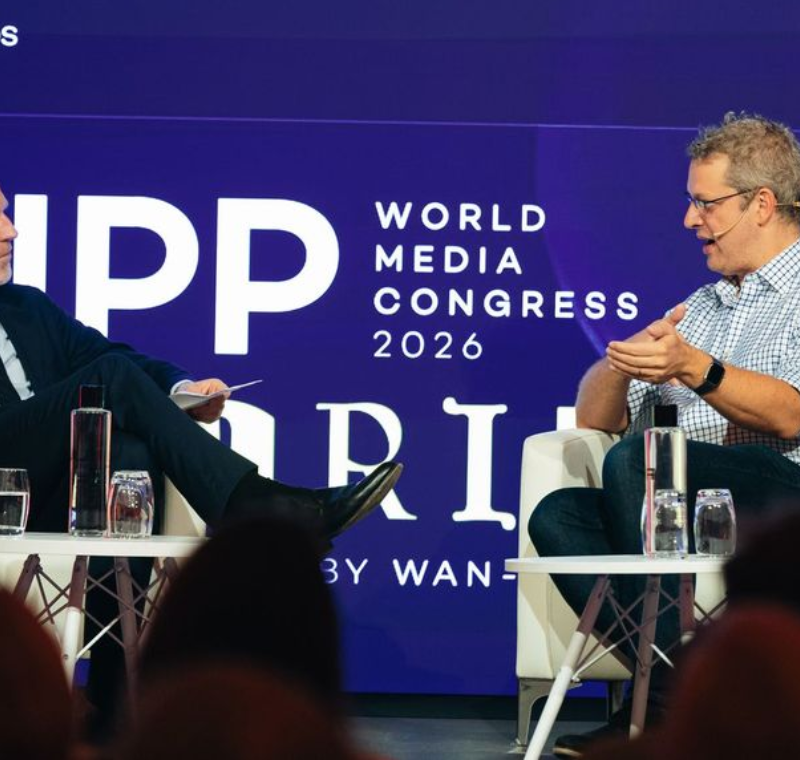
Lulu Skantze put this question to publishers at FIPP World Media Congress in Madrid today, as she argued that the industry needs to think much earlier about where its future audiences come from.
Speaking alongside Yulia Boyle, Chair of the FIPP Advisory Board, during the launch of FIPP’s Kids Trusted Media initiative, the publisher and co-founder of Storytime magazine said children’s media should not be treated simply as another product category, but as the beginning of a lifelong relationship with readers.
“What if we stop valuing the monthly value of a subscriber and decide to consider the lifetime value of the subscribers we are raising?” Lulu asked. “How are the kids we are serving now going to become the adult customers of your products when they grow up? How would they know what a magazine is if they have never seen one?”
Less than 10% of the UK magazine market serves children and teens, something Lulu linked to an industry that has become highly skilled at selling individual products, but far less deliberate about building the audiences who might buy them in future. “There’s no pipeline,” she said.
Raising readers, not just selling copies
Lulu, who chairs the Kids Trusted Media Initiative, drew on more than a decade working in children’s publishing to show how easily short-term sales mechanics can take over. She recalled a meeting around 2010 where a previous issue had sold particularly well with six cover gifts, prompting a discussion about whether the next issue could carry seven.
“We became very good at selling the wrong thing,” she said. “We spent all our time and budget luring children in for the plastic instead of the stories inside – that wasn’t sustainable then, and that was 15 years ago.”
Her argument now is that “raising an audience has to sit at the centre” of brands: “Magazines are excellent at building habits, trust and belonging,” she said. “Nobody else does the job magazines do: engaging readers and having those continuous conversations.”
The difficulty, she acknowledged, is that children’s media has more than one audience to win. Families, schools, councils, NGOs and brands can all act as gatekeepers before the content ever reaches a child. “Everybody has different benchmarks. They need to trust you,” said Lulu. “And once you pass through that, the kids need to love you, which is another battle altogether.”
She also argued that publishers are often too quick to decide that children are not interested. Adults may leave a magazine sitting around until the right moment to read it, she said, while children are often expected to engage immediately.
“Kids need the same freedom. They need magazines to be around them for their discovery to happen.”
Lulu pointed to Storytime’s 800,000-copy special edition, produced with The Reading Agency and funded by Universal Music Group UK, as an example of the scale that can be reached through partnerships beyond traditional retail. The project took Storytime into a national literacy initiative, while similar opportunities, she said, exist through schools, charities, NGOs and brands looking for trusted content.
Making trusted media easier to find
Yulia Boyle, who initiated the Kids Trusted Media Initiative, then asked a more practical question: how does the industry make trusted children’s content easier to identify, fund and distribute?
“To raise the new generation of discerning readers is our responsibility,” she told delegates. “But responsibility alone is not changing anything. We need a mechanism.”
The first phase of the Kids Trusted Media Initiative, launched by FIPP and WAN-IFRA, centres on three areas: a trust mark for qualifying children’s media, better access to buyers such as schools and funders, and stronger category data for the industry. “We want to make this content recognisable. We want to put it in front of buyers, and we want to give you data to make sure you have the proof,” Yulia said.
For schools, funders, technology companies and other organisations buying or licensing children’s content, she boiled the proposition down to three qualities: “trusted, proven and human”.
The first part of the initiative is a quality mark for children’s media. “Think of it as a Fairtrade label on the cover of your magazine or on your website,” Yulia said. “Only FIPP and WAN-IFRA can put a mark on a children’s magazine anywhere in the world.”
The second element is access. “We’re going to open doors to schools, retailers, libraries, funders and corporations,” Yulia said, with FIPP and WAN-IFRA using their international networks to increase the visibility of participating titles and create new routes to revenue for trusted children’s content.
The third strand is data. Yulia explained that the initiative wants to build a clearer picture of children’s magazine media across print, audio, video and digital, creating evidence publishers can use with buyers, partners and investors. “Nobody currently measures magazine media – print, audio, video and digital – as a category,” Yulia told delegates. “We are going to give you that number.”
The initiative already has founding members across several markets, including TIME for Kids in the US, Future plc’s The Week Junior, Creature & Co., publisher of Nat Geo Kids in the UK, Australia and New Zealand, NewsMag Media in Ireland, Papo Editora in Brazil and the Finnish Magazine Media Association. Yulia told delegates that more media companies are continuing to come forward.
Delegates were also given the first edition of The State of the World’s Children’s Media, a new briefing bringing together research on children’s reading, media use, AI and trust. The report notes that existing research often folds magazines and trusted human-made media into broader categories such as “digital media” or “reading”, making the category harder to see clearly.
A nutritious alternative
Both Lulu and Yulia argued that publishing could learn from sectors that already invest deliberately in future audiences: Yulia pointed to sport, where clubs and leagues deliberately cultivate fans from childhood; Lulu made a similar comparison with fashion, cinema and music.
“They nurture audiences, so they have future customers,” Lulu said. “Why don’t we?”
Yulia also highlighted new youth publications trying to offer something deliberately crafted, physical and human, describing the opportunity as creating a “quality, nutritious alternative to this industrial-scale slop”.
The initiative is now asking media companies to nominate senior representatives to its Trusted Kids Media Committee, with the trust mark, buyer access and category data work set to develop through the participating network.
Yulia closed the session by reminding the audience that “early readers, lifelong readers, are lifelong buyers.”
Click here to download the report on the World State on Children’s Media and submit a nomination to the Kids Trusted Media Committee.