
How Boom Saloon’s new membership model is deepening reader relations
Boom Saloon is a multi-faceted, Edinburgh-based media organisation comprising magazine-making, a creative studio space and community projects. Its aim? To democratise creativity for good within a volatile media industry. Profits from the print magazine and creative studio fund the community projects, which in turn inspire and empower those facing societal and creative challenges such as forcible displacement, homelessness, and dementia.
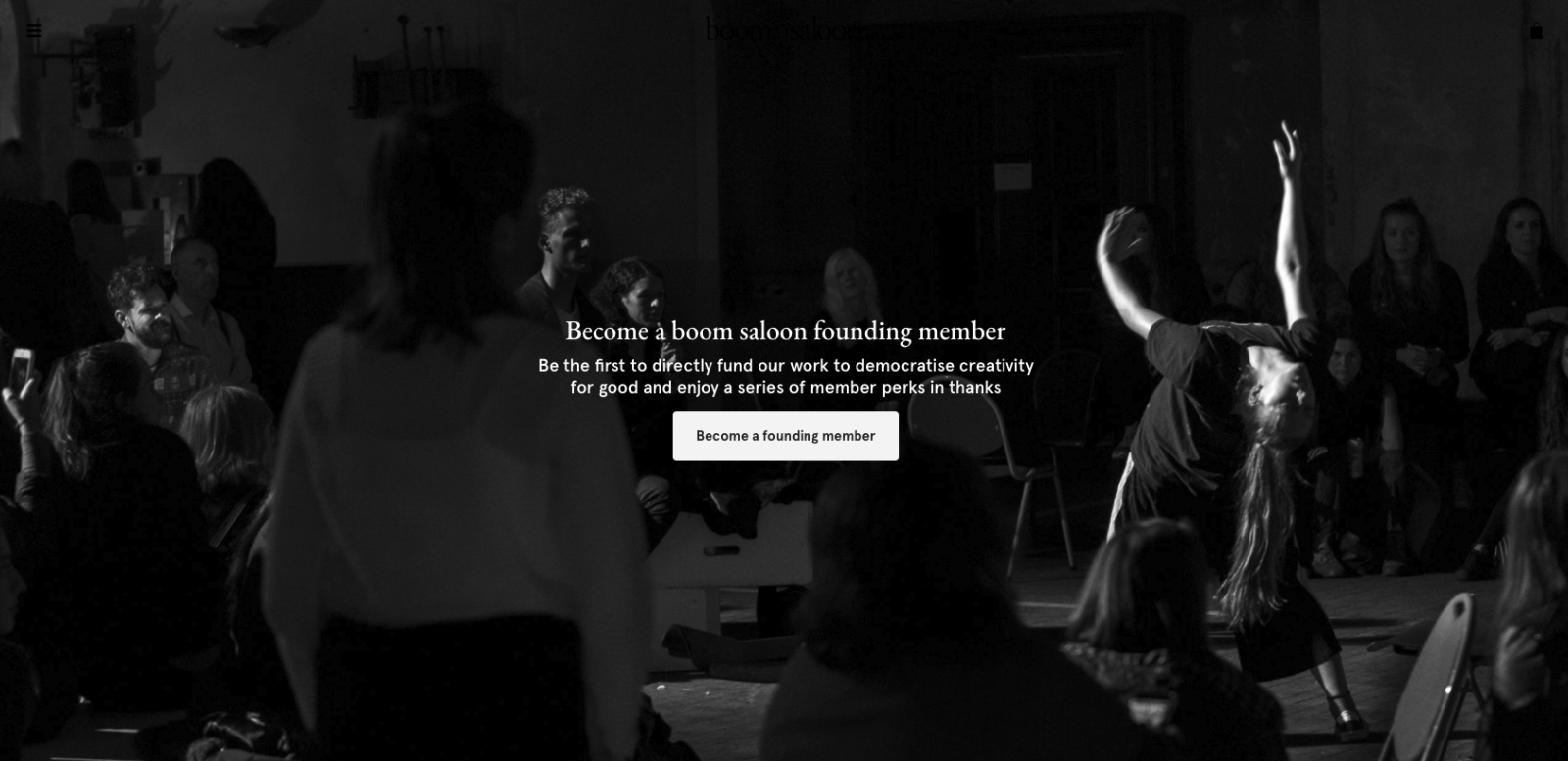
In October, the Boom Saloon team launched a new membership initiative to deepen the relationship with their community. Their supporters have been given the chance to become ‘founding members’, a level of membership that offers numerous perks, such as access to a network of creative practitioners and the full digital archive of features, plus exclusive discounts for products and events. Crucially, however, it gives members an opportunity rarely seen in media organisations – to contribute directly to the evolution of the business; to have a say in the stories shared across their entire media ecosystem, alongside the events they hold and the collaborations they spark. Here, founder Rachel Arthur explains the motivation behind this new membership scheme – and how to take the concept of developing reader relations to a whole new level…
Why create ‘founding memberships’?
It’s something we’ve been bouncing around for a long time. We wanted more connection with our community, but we’ve known for a while that subscriptions, for example, don’t work for us with our model and what we’re trying to achieve. ‘Membership’, on the other hand, always felt like it had a lot of potential – we just wanted to make sure we did it right. Our first attempt – I’m very happy to say – we got wrong, straight off the bat; we threw it behind a hard paywall, which, when you’re trying to democratise creativity, does not work. That idea of testing and reiterating has always been part of Boom Saloon’s principles, and we put this to use with our memberships. Now in 2023, we have a much smoother and more refined version, which feels a lot more aligned with us and what we stand for.
Where did the idea come from?
The decision was led simultaneously by our own research project, and by input from our community – something we have always regarded as extremely important. Our members told us that they wanted more opportunities to directly support our community projects; at that time, the only way people could do that was by buying a publication, or commissioning our creative studio, and if you had all our magazines and didn’t have a need for a studio, you didn’t really have anywhere to go. Thankfully, we have a really engaged community who gently told us they wanted to be more involved. It goes back to a basic, obvious principle: ask your audience what they want, and they will tell you.
How is it different from your existing standard membership?
Our standard membership gives members chance to pay to directly support our community projects, and in return they receive a series of discounted content and invitations to events. What’s more exciting about founding membership is that you actually have the chance to shape the future of Boom Saloon. Founding members will have a say in the stories that we share, the events that we run, the projects that we collaborate on. We’ve looked at a lot of membership models, both in publishing and wider industries, but have seen very few that allow that level of access and agency.
I believe you have already had one founding member involved…
Yes, we brought along one of our founding members to our last full-day strategy session. I won’t lie, having someone who was not core team pick apart our strategy was daunting and different and quite scary. But it felt good to be able to say that we are genuinely actioning this, that we are opening that door.
How does this tie in with Boom Saloon’s principle of ‘democratising creativity’?
As soon as we put ourselves in the creative industry space, we knew that we wanted to do some good. One of the most pressing problems is access and inequality; it just cuts across everything, and I really believe that it holds back the industry. For example, there are many arguments for creative thinking being a lot more agile and being based on experience as opposed to education. I also think that the industry as a whole – and I’m not going to mince my words here – is rife with nepotism. There are huge barriers to access that simply shouldn’t exist. As soon as we started doing the work to find these often-overlooked or under-valued voices, we realised that the talent within that space is unbelievable, and so raw. I worry that if we rely too much on the minds that have had the same formalised training, we will have too many of the same opinions and approaches to solving problems. This membership model, we hope, will help us mitigate this.
One of the challenges of democracy is that it can be difficult to come to a consensus or make decisions. How will you factor that in?
As I’ve said, there will always be an element of iteration to what we do. But it comes down to our manifesto, which has been carefully considered and is very clear. Having this simple 12-page document has meant that making big decisions is easier. We don’t have to think twice about what is right for us, or what is more tangential – the decision is made for us. If we share that with all our founding members and make sure that they understand it, I hope that that will really help things going forward. When it comes to new ideas, it will help us decide where to tweak, where to massage, where to clarify, so that it fits with what we’re all collectively trying to do. When we’ve got more people in the mix, it should help to make sure that everyone feels like their voice has been heard.
What are the benefits to you?
We have someone who, as a paying member, understands what we do, but is also coming at it with fresh eyes. They’re not seeing or as concerned with the minutiae of our day-to-day, or our various roadmaps and targets. So that’s refreshing, and really helpful. Our general membership community is already very involved, but since we’ve launched founding memberships, a couple of people have already started to challenge us on this idea of ‘democratising creativity’ and what that means. I love that. It’s good to have genuinely constructive – and sometimes quite fiery – conversations about challenging topics. Speaking with our community really shapes and forms our projects into something that aligns with what we’re doing.
It takes the idea of ‘engaging your community’ – something that’s talked about a lot in media and publishing – to a whole new level…
Yes. In the last couple of years in particular, people have really bandied around the phrase, ‘deepening reader relationships’, but I’m not convinced by the way some companies do that. Some people seem to think they just need to send a survey and tick, that’s done. But what we’re doing at Boom Saloon feels like a way to actively deepen those reader relations.
How does that tie in with your print or publishing strategy?
Our print strategy has definitely evolved. At the beginning I thought we’d flip it every quarter, and everything would meet publishing schedules. But as soon as we started running the projects, we realised that wasn’t going to happen. Now, our publishing schedule has changed focus, so we’re not only thinking of producing a condensed, abridged Boom Saloon, which would allow us to produce a magazine more frequently, we’re considering other publications that we could run off the back of it. For example, Freeform, our dot matrix-printed ‘non-white paper’, was a spin-off from an event, which in itself was a spin-off of a conversation with some contributors. It’s all become more connected than it ever has been before. And the strategy behind that is: rather than trying to reinvent the wheel every single day, why don’t we work with something that’s already there?
How do your members feel about print publications?
There is still a really strong demand for print from our members, which I’m happy about. They really liked the idea of being part of Freeform, knowing that what they said at an event is now sitting on the desk of the politician in charge of that particular space. But when it comes to print, we have to be strategic. We’re looking to address waste in the industry, so we want to be confident that we’ll sell out of a print run. That comes from having the foundations of a membership that you can sell into.
For more information on Boom Saloon’s founding membership and their various print- and community-based projects, visit their website.