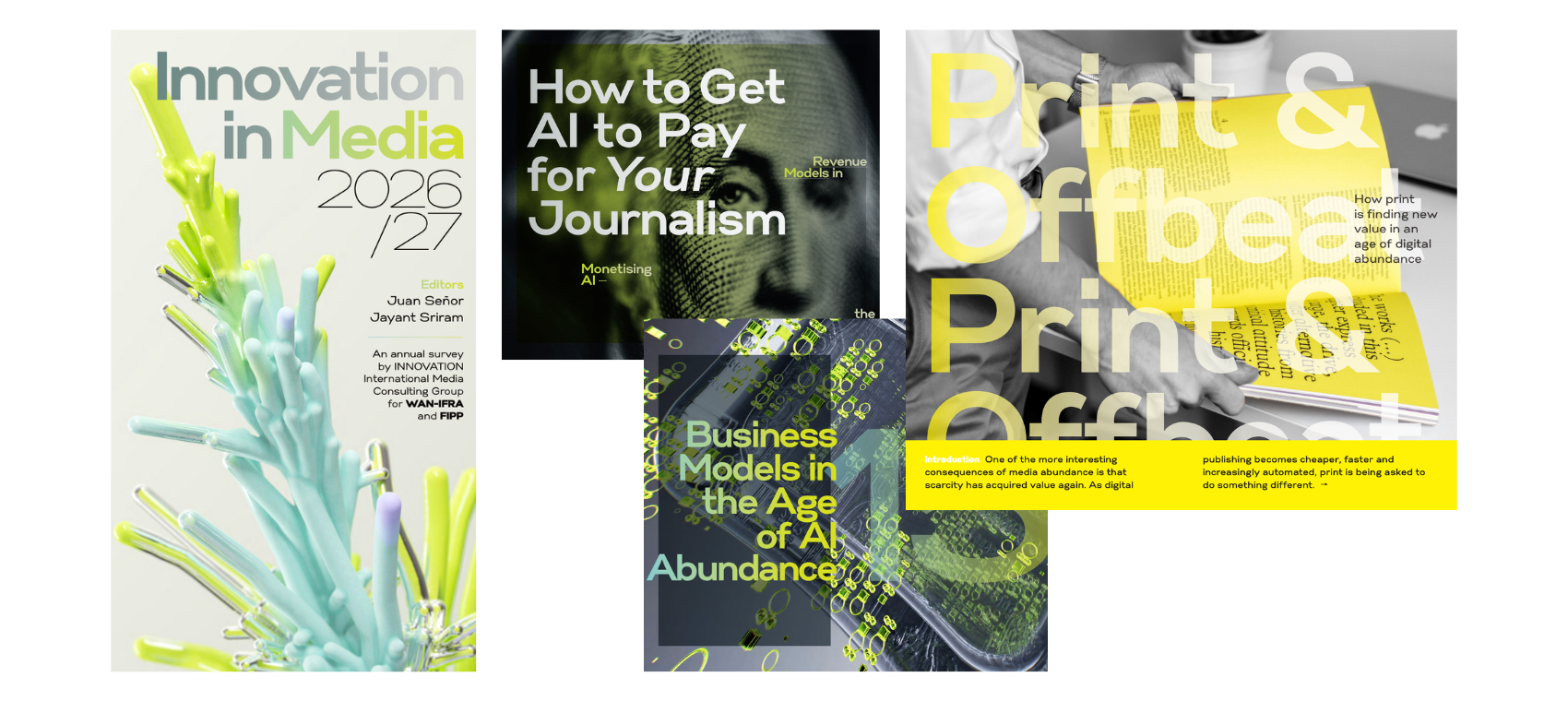
Innovation in Media World Report 2026/2027 turns spotlight on AI monetisation, reducing platform dependency and the value of print
Offering invaluable insights into how media leaders can negotiate structural change in the industry, the Innovation in Media World Report 2026/2027 was unveiled to delegates on the first day of the FIPP World Media Congress.
How to make money in the AI Age; building defensible audience relationships; creating an AI-native newsroom; and the ways print is finding new value in a time of digital abundance are all topics covered in this year’s study, authored by Juan Señor and Jayant Sriram of Innovation Media Consulting in partnership with FIPP and WAN-IFRA.
Drawing on global cases across six chapters that act as a practical guide to publishers, the report reveals the most profitable developments impacting media today and is compiled using a vast network of consultants around the word.
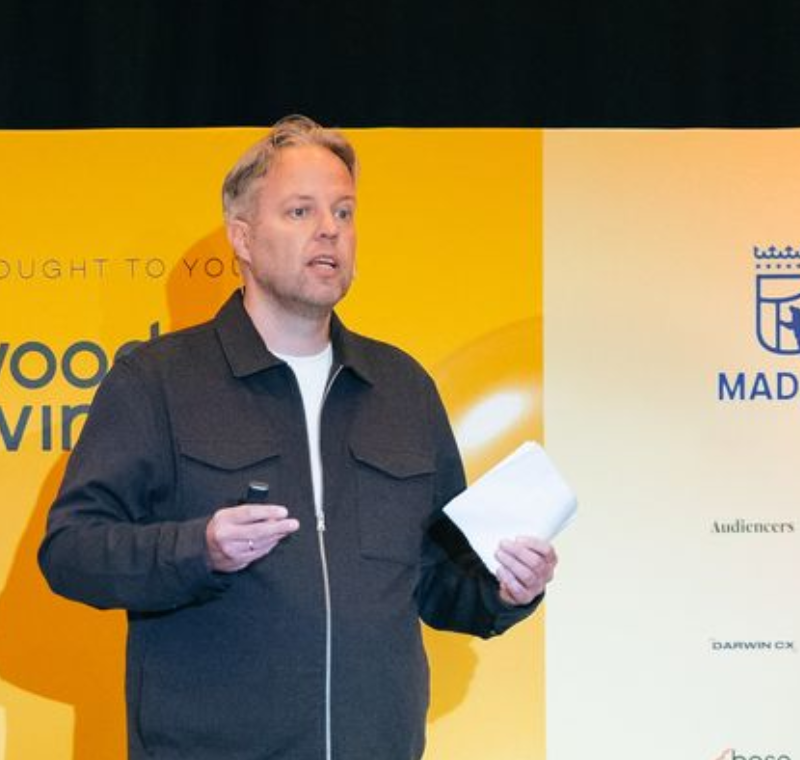
“We’re in the electric age meeting the Enlightenment Age, and it is existential and it’s incredibly profound,” said Señor, presenting the report with Lucio Mesquita, Senior Consultant at Innovation Media.
“And I think it’s important for us to realise exactly what that means for us. It’s the Electric Age because these people have invented what some people say is a plagiarising machine. It’s a reasoning machine with zeros and ones that is superpowered by these data processing chips – and is as big as electric because it’s universal and it can access anybody.
“And at the same time, we’ve got the democratisation of knowledge. You’ve got knowledge that is available to me in every single way I want it, whether it’s informational or interpretative. It’s an incredible combination for us.”
Keeping an eye on AI
Addressing the issue of our time, the report scrutinises the huge impact the rise of AI has had – and in particular how publishers can benefit financially.
The study takes the core revenue models – licensing content, subscriptions, membership, intelligence products, events, commerce and data – and organises them into a clear framework for building durable income when content itself is no longer scarce.
“We’re in an incredibly profound moment of disruption, and I’m afraid we’ve seen a lot of publishers that are not reacting to the age and to the moment. There’s denialism – people that just using AI to cut corners and to amplify existing content and so on.
Licensing, data partnerships, AI-powered products, advertising models and enterprise services are all explored, with a focus on turning content and archives into active revenue streams rather than passive assets.
“In this new AI age, where is our value?” Señor said. “If you look at it in the print age, it was distribution. That was our advantage: the kiosks, delivery at home, in the street. In digital, it was data. We had massive data, massive traffic, and through Google and others, we monetised that data.
“In the social age it was attention. And now it’s really about monetising truth, because we’re in an age of artificial credibility.”
The study looks at how publishers can optimise content for AI. “How can you be better for AI? Make it readable,” said Mesquita.
“AI tools are basically a bit like teenagers. They like to give me the bullet points, give me the summary. I don’t want to read the whole book. Just tell me what happens in the end, so they can pass my exams. It’s how it behaves a bit. So, think like that, and prepare the content like that as well.”
The report shows that journalism is no longer primarily in the business of producing information – it is equally also in the business of guaranteeing its integrity.
To do this, news organisations must rethink not just what they produce, but how they produce it. Trust can no longer be treated as a byproduct of good journalism. It must be designed into the system itself – through workflows, technologies, and governance structures that make the origins, methods, and accountability of content visible and verifiable.
“Scarcity has moved from content to trust,” Señor said. “And think about your readers; they’re really asking, ‘Is it true?’ They know what it’s out of there, but they’re asking you. They’re asking us: Is it true? So, our specialist media has to move into tell me something I don’t know, which is true.
“We need to move from defence to offense, and the way you do that is by making sure that they know that your content is verifiable, human-made journalism, and the conversation has to change from where we are today as an industry, very defensive, you’re scraping my content, to – you need my content, and why?
“Because we live in a world of lies, and we are the ones that can produce the truth, and the truth is what people will find the most valuable when they search.”
Transforming the workplace
The report devotes a chapter to building an AI-native newsroom – looking at organisational design, workflow transformation, the role of AI agents, and the redefinition of editorial roles.
Emphasis is placed on integrating technology at the core of operations rather than layering it on top. Where AI were once tools, now they are workflows.
The report points out that while AI can filter, summarise and organise information
at scale, it struggles with credibility, context, and editorial judgement.
Journalists consistently emphasise the need for transparency, especially the ability to trace outputs back to original sources. AI can take on more of the mechanics of journalism, but it does not remove the need for judgement. If anything, it makes that role more visible.
“It doesn’t matter if it’s a newsroom of one or a newsroom of several. The principles ought to be the same, and I think this is probably the key one we all have to think, both from a content generation and business concept as well,” said Mesquita.
“Decide the balance between augmentation and replacement. What is that? Augmentation is about what you do more of, how you improve what you offer using AI. It may be versions, it may personalisation, it may different elements you build as part of your content, all that’s augmentation.
“Replacement is simply replacing what some of your teams currently do to be automated through AI tools, and it’s quite key. I mean, we see some sometimes saying, ‘Okay, great, I’ll automate everyone’. You know that there are some new services completely machine done. That is the extreme of replacement. And please, if you’re toying with that idea, don’t.”
How to own direct audiences
The Innovation report clearly sets out strategies to reduce platform dependency, strengthen first-party relationships, and build defensible ecosystems across newsletters, apps, (v)pod casts, communities and journalist-led brands.
This chapter explores how the move away from platforms towards direct audience ownership is not a single strategic adjustment, but a broader reconfiguration of how media organisations approach distribution, data, and engagement.
What is emerging is a model in which the value of an audience lies not only in its size, but in the depth and durability of the relationship behind it.
The report also devotes an entire chapter to how print is finding new value in an age of digital abundance.
It shows that print can make a statement precisely because it takes up physical space; start conversations rather than simply chase attention and offer respite from digital distraction – making information, ideas and brands more memorable
Through examples from around the world, the study show how some of the most interesting media experiments now sit awkwardly between traditional categories: part publishing, part technology, part experience, sometimes barely recognisable as media in the conventional sense.
What connects them is not a set format but an understanding that, in an age of near-infinite content, innovation can sometimes mean creating something with limits -tangible, situated and difficult to reproduce at scale.
“I know it’s bold for us to pretend that we are the guardians of the truth, but I think it’s appropriate, and I think it’s a fantastic positioning, but needs to be articulated,” Señor said, summing up.
“If we’re just media companies that produce information, our narrative towards the readers, towards the advertisers, and towards these new platforms that are building the internet has to be confident in saying we are the people who’s going to tell you the truth in a world of lies. Media can and should, and I think that’s our value now more than ever.”
Print copies of the study were handed out to delegates at the FIPP Congress while a digital version can be downloaded here.