
Against ‘beige’: Media strategist Dmitry Shishkin’s non-negotiables for the AI era
After 21 years at the BBC and senior roles at Culture Trip and Ringier, Dmitry Shishkin now advises major media organisations. Here he argues that the industry’s most urgent problem isn’t AI, declining trust or commercial pressure – it’s the inability to accurately name what’s actually wrong.
His move to independent advisory work was, Dmitry Shishkin says, deliberate – a way to work across more organisations at the moment when outside perspective is most valuable. And as a result he has seen a consistent pattern.
“The problems facing the media right now are structural and strategic,” he says. “They don’t need another internal voice. They need someone who’s seen the pattern across enough organisations to name it clearly.” The move from CEO of Ringier Media International to independent adviser was, he says, deliberate – not a retreat from the operational world, but a way to work across more organisations at the moment when outside perspective is most valuable.
The pattern he names most often is the gap between stated ambition and actual behaviour. “Most organisations confuse transformation with renovation. They reorganise teams, rebrand the strategy, and invest in new tools. Sometimes organisational charts change, sometimes they don’t – in most cases, the behaviour doesn’t.”

Dmitry Shishkin will be speaking at the FIPP World Media Congress in Madrid, 13-15 October 2026. (Launch Tickets Offer valid until 31st May. Prices will increase by €200 after this deadline.)
What defines the newsroom of the future
What actually makes the difference, he says, is less visible and harder to sustain.
“It’s whether the editorial team genuinely understands why a particular piece of content exists – what job it’s doing for an audience, not just what story it’s telling. It’s whether commercial, product and editorial teams share a model of audience value, or operate in permanent translation mode.”
His framework for this is the Indispensable Newsroom model, built around audience value as the organising principle for every structural and operational decision. “The newsroom of the future isn’t defined by its tools or its headcount,” he says. “It’s defined by whether every part of it can answer the same question: what does this do for the people we exist to serve?”
In an AI environment, this question becomes more pressing. Dmitry has championed the user needs model since his BBC days, and argues it holds more now than it ever did. “When a significant share of information retrieval moves to AI-mediated answers, the content that survives is content that does something a summary can’t – the need to be inspired, to feel part of something, to be guided through a decision, to understand context that data alone can’t provide.”
It’s time to use a structural advantage
There is, he says, an alternative. “The user needs model was always an argument against undifferentiated content production – something I describe as ‘beige’,” he says. “If you can’t articulate what need your content is meeting, you’re producing content for an audience that may no longer need it or come to find it. Distinctiveness, originality and helpfulness are the three pillars your content should rest on.”
For specialist publishers, he sees a structural advantage that many are failing to use. “You know your audience in a way that a general-purpose AI can’t replicate. The question is whether you’re building your editorial and product decisions around that knowledge systematically, or still defaulting to output volume as the measure of success.” The mistake he sees most often is specialist publishers benchmarking themselves against general media: “The publishers who will thrive in the next decade are the ones who go deeper, not wider.”
On leadership, he describes the senior leader’s role as implicitly that of a ‘Chief Mindset Officer’ – and argues that navigating the current environment requires a specific kind of clarity. “They hold clarity about what their organisation is for – not what it does – and they use that as a decision filter,” he says. “It’s not enough to have a clear mission statement; it’s about operationalising it for everything your teams do.”
When it comes to trust, a conversation with a former BBC colleague has stayed with him. “Trust is not a prerequisite for consumption – consumption builds trust, through regularity, consistency, and reliability over time.” In other words: that trust is not a brand position to be declared, but a habit built through consistent performance.
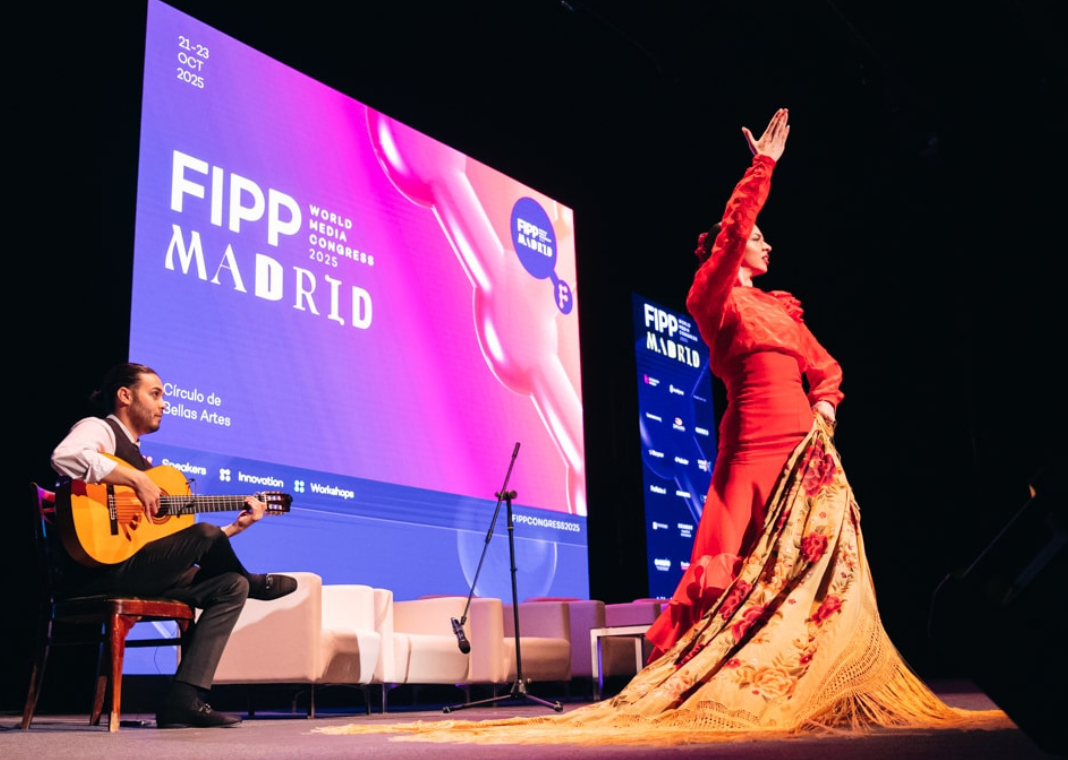
48th FIPP WORLD MEDIA CONGRESS
13-15 October 2026, Madrid, Spain
Last few tickets remaining!
Join the global media community in Madrid before the final places disappear.
Want to stay where the action is?
Contact us to find out about accommodation at the Congress venue, Hotel RIU Plaza España.
Three non-negotiables
He is direct about where he thinks the industry needs to start – and offers three non-negotiables that apply regardless of scale or market. The first is a genuine, operational understanding of audience, “not demographics or readership numbers. What your audience actually needs from you that they can’t get anywhere else. If that answer is vague, everything built on top of it is unstable.”
The second is alignment between editorial, product and commercial around a shared model of audience value. The third is the one he says is most often missing. “A leadership culture that celebrates honesty. I see too many organisations that have sophisticated strategies built on an incomplete or flattering account of where they actually are. The fundamentals don’t work if you’re applying them to a problem you haven’t accurately named.”
The good news, he says, is for specialist media, “all three of these are achievable. The audience is often closer, the relationships more durable, the editorial identity more distinct. The question is whether that’s being used as a strategic asset or taken for granted.”
The FIPP World Media Congress takes place from 13-15 October 2026 in Madrid, Spain.
Current pricing ends May 31st.
FIPP & WAN-IFRA Members: €1290
Non Members: €1790
FIPP Congress 2026 sponsors