
Les Coops de l’information and Poool on how to succeed in digital reader revenue models
A couple of years ago, Québec City newspaper Le Soleil and five of its sister titles found themselves in dire straits and close to bankruptcy. Remarkably, the group of publications, now part of Les Coops de l’information, has pulled itself back from the brink to a point where the media group is thriving with more than 1.2m unique users and 370,000 print readers each week.
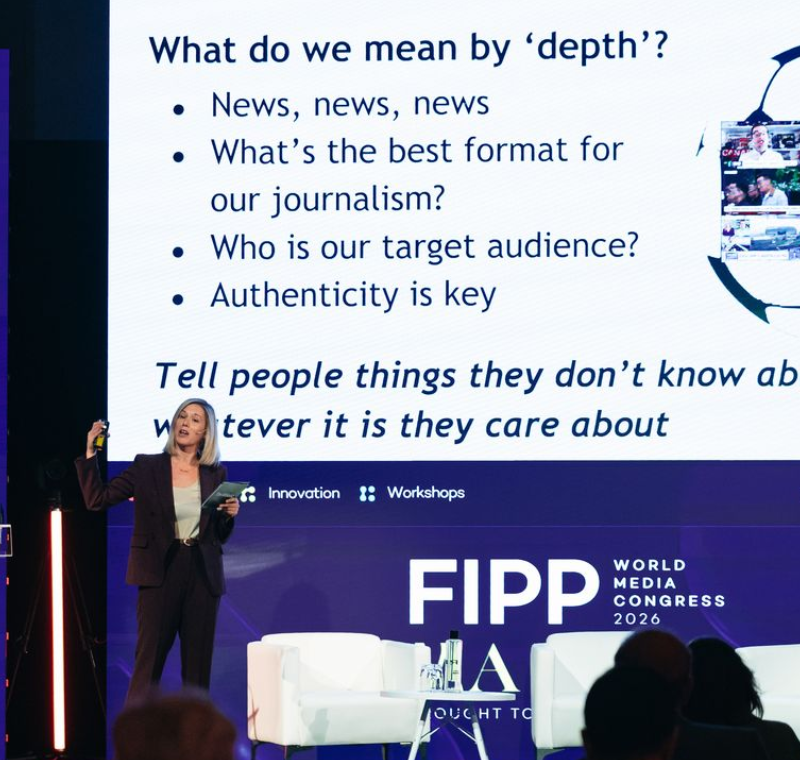
Crucial to Les Coops de l’information’s turnaround has been a plan to accelerate its reader revenue journey. At a recent FIPP Webinar, Marc Grendon, Senior Director at Les Coops de l’information and Publisher of Le Soleil, sat down with Madeleine White, Head of International at digital subscriptions company Poool, to talk about the group’s extraordinary comeback.
“We were a couple of $100,000 away from bankruptcy, so what we did in the past few years is probably a miracle,” said Grendon. “We have come a really long way.”
According to White there were lot of important lessons to learn from Les Coops de l’information’s digital transformation journey as a legacy publisher: “The strategy they have put in place, and what they are continuing to do, is very impressive and almost puts into practice all of the best practices that we put forward.”

A history of resilience
At one time things became so dire for Le Soleil and the five other French-language newspapers that’s part of Les Coops de l’information that, in 2019, the Québecois government lent then owners Groupe Capitales Médias millions to keep the newsrooms afloat while they searched for new owners.
While there were some interested buyers, the employees took it upon themselves to save the titles by forming Canada’s largest newsroom cooperative, with Les Coops de l’information being born at the start 2020. Part of the groups’ future plans was to launch digital subscriptions within 12-18 months. Then Covid hit.
In March 2020 Les Coops de l’information was forced to suspend its weekday print editions and put all its effort into its digital transformation, endeavouring to put digital subscription plans in place in just 12-18 weeks.
“We had a website at that time, but we didn’t charge anything to access the content,” explained Grendon. “We were relying mostly on our print revenues, like distribution revenues and advertisement revenues, and we were gaining some share parts in digital advertisement too.
“But we realised that if we wanted to become sustainable in the digital landscape, digital advertisement revenue wouldn’t suffice by itself. We had to add other revenue sources. So that’s why we decided to launch digital subscriptions. It was important that we didn’t stop our chances of growing digital advertisement business in favour of switching to subscription-first.”
Les Coops de l’information decided to have paywalled content where every user would have access to three free articles per month. If you created a free account, you would have six free three articles per month. If you signed up to become a fully-fledged subscriber, you would have access to all content.
Les Coops de l’information rolled out three levels of subscription – a basic one, where users had access to digital content; ‘digital all inclusive’, where they added the E paper replica of its editions; and ‘paper and digital, all included’ where you got print editions as well.
To decide how many articles got put behind a paywall, Les Coops de l’information analysed the traffic and behaviour of their users across platforms – a crucial step according to Madeleine White.
“How many articles to offer free before the paywall is a huge question and actually there’s no single reply,” she said. “There’s no magic formula, but one really interesting KPI is measuring how many articles the average reader reads or segmenting your readers into different engagement groups.
“On the Poool dashboard you do this natively. We have four engagement groups – volatiles, occasionals, regulars and fans, who are the most engaged. If you’re an anonymous reader, who on average is from 80% to 90% of your audience, and they’re reading only one or two articles per month, that gives you a brilliant idea of how many articles you can offer for free per month without blocking these volatile readers who you’re monetising just through advertising, and who aren’t likely to subscribe.”
Through anaylising users, Les Coops de l’information discovered that a huge majority of users didn’t consume more than three articles per month. “For us it was important that we could still keep on monetising these people by showing them advertisements,” said Grendon.
“And then there was this 1% of highly engaged users that we felt we could convince to become subscribers – and that’s what happened. These people jumped onto the subscription bandwagon to help us with our mission of creating world class local news.
“It was clear to us that no sole source of revenue would be profitable enough or sustainable enough to allow us to face the future. And this (realisation) came from our print experience. In the past, we were maintaining our distribution network solely because advertisement was financing these operations, so we could distribute a copy of our print edition and lose a dollar in the operation. It wasn’t that bad because we knew that advertisement was there to fill up the gap and even make the operation profitable.
“But this is something that probably accelerated the downgrading of our revenues in print, because at some time advertisers flew out of print to embrace digital. And at that moment our print editions weren’t financially sustainable anymore. So that’s why we’ve decided just at the end of last year to completely stop our print operations and become a fully digital enterprise.”
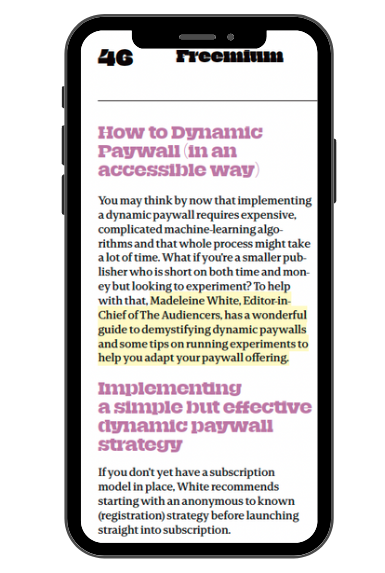
Learn more about Madeleine White’s subscriptions strategies in our recently launched
INNOVATION IN MEDIA 2024-25 WORLD REPORT
Authors Jayant Sriram and Juan Señor of Innovation Media Consulting look at the newest, hottest, most profitable developments impacting media today.
Topics include AI-Powered Media, Freemium Paywalls, First-Party Data, Bundles, Print, and 10+ Business Models for revenue growth.
Balancing frustration and engagement
White stressed the importance of finding the right balance between frustration and engagement when drawing up a conversion strategy.
“You can continuously increase engagement on site, but that’s not how you monetise your readers – you do that through giving access to articles through your newsletters, through push notifications and interactions with the community,” she said.
“You continuously increase this engagement, but the frustration is where the paywall comes in, or something that blocks you or stops you from doing something. Even advertising is a form of frustration or bad user experience. And the higher the engagement, the more that counteracts a frustration.
“If each reader on your site has a different level of engagement and has a different context then it means they are going to react differently to different levels of frustration. Say someone is very engaged and you block them with a paywall on their first article, they’re going to be more likely to convert because their high level of engagement counteracts that frustration, and it means that it persuades them to convert.”
If first you don’t succeed
A lesson Grendon learnt from Les Coops de l’information’s print days that stood him in good stead when launching a paywall was to not be obsessed with finding the perfect solution straight away.
“When we made the change to our new CMS and our new paywall solution, our main objective was to start small and start iterating from what we’re learning, because it’s the only way to make some real improvements over time,” he pointed out.
“If you find the right recipe at the first attempt it’s only luck. The only way you can move forward is testing new things and learning on your journey. Sometimes you’re going to miss the point, but it’s not dramatic. That’s the good thing of doing small tests with a small group of users and you say: OK, am I moving straight into the future or straight into a wall? And then you can reassess and start again.
“But if you’re moving in the right direction, then you can just increase the temperature – like enlarging the group to which you’re showing the offer, and then readjusting over the course of time. So, one of the other components of the digital mindset change is that you don’t try to be perfect at first. Start iterating and learn from every test you’re doing.”
See the full webinar here: