
Media coverage of America’s political January: The shifting role of media
As if not to be outdone by 2020, January 2021 in America came in with a political bang. Over the past three weeks, the country has seen both a violent insurrection with Trump supporters breaching the Capitol for the first time since the War of 1812 and the inauguration of Joe Biden as the 46th president of the United States.
But as much as the media’s coverage of the two events differed based on the outlets themselves (Vogue’s coverage doesn’t look like the Wall Street Journal’s, nor should it), perhaps more telling is the way each media title’s coverage of the events of January 6 differ from its own coverage of Inauguration Day on January 20.
Certainly some of the discrepancies in this coverage can be attributed to the Trump Bump—media outlets doing their best until the very last possible moment to report and capitalise on the chaos and horror that has been the Trump Presidency. But, at risk of being too optimistic too soon, the shift in coverage from the insurrection to the inauguration reflects more than just a shift from a Republican to a Democrat, or even from an unpredictable hurricane of disaster no one can negotiate with to a normal, functioning human being.
In the age of social media, where anyone, brand or individual, in the public eye (except the former president, apparently) is held accountable for anything they do or don’t say, an unhinged, deeply polarising president puts specific demands on public voices. In this environment where silence on an issue or an event is more often than not taken as tacit approval, or at least indifference, there is a heightened pressure on everyone from journalists to Instagram influencers to respond to events in the news, even those outside their usual scope. The Trump presidency only exacerbated this situation by presenting us with a 24-hour news cycle so extraordinarily chock-full of off-the-wall statements and behaviour that media organisations effectively had no choice but to report and respond.
With Biden’s inauguration, the obligation, even the personal sense of duty, to cover political events with that same Trump-era intensity diminished a bit. If this shift from January 6 to January 20 can be taken as a sign of the media landscape to come, it seems that slowly, media titles are starting to shift back to their wheelhouses. Obviously, the difference between reporting on a deadly, riotous act of sedition fueled by racism, hate, and a refusal to accept truth and the inauguration of a new president is significant. But the coverage of the two events does suggest media outlets are again starting to be able to report in their own style, without the influence of either the Trump Bump or the Trump Pressure.
While every media title we looked into had at least a base level of coverage of the events—what happened, where, why—the places where they diverge speak volumes not only about each individual title’s angles, but about the state of American media today.

Here’s a closer look at how some of the United States’ most prominent media titles covered the events of this year’s historic first few weeks.
New York Times
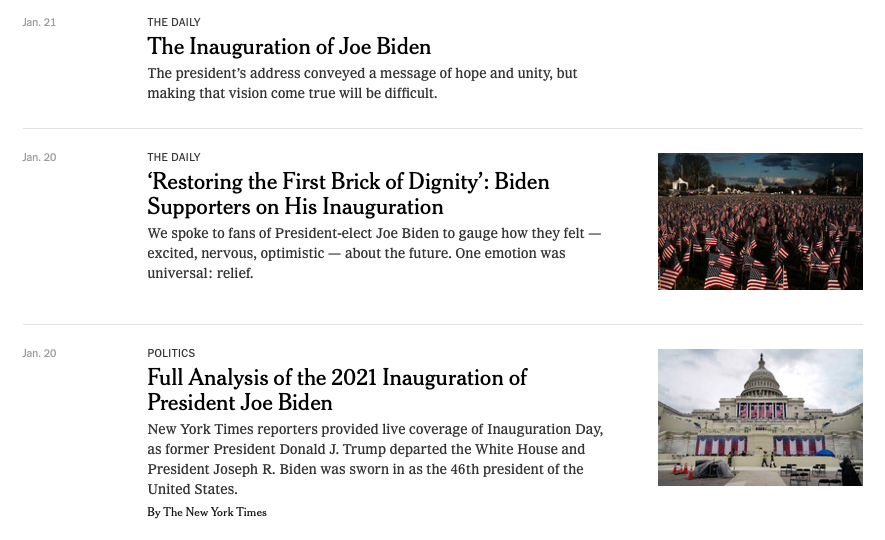
The New York Times, which throughout Trump’s presidency has given a platform to the ideas of his supporters in its print and audio reporting in the interest of objective journalism, had extensive coverage on the events of January 6, all accessible from a “Capitol Riot Fallout” easy navigation panel. Its reporting was comprehensive and largely fact-driven, offering a play-by-play of the events, reflecting on Trump’s responsibility for coordinating and encouraging them, and reflecting on what this means for the Republican party. Compared to some other media titles, the New York times took a relatively neutral tone, condemning Trump’s and the rioters’ behavior but sticking primarily to numbers and direct quotes.

The New York Times covered nearly every aspect of the inauguration. Their tone was one of cautious optimism and a commitment to reporting the facts. While some reporting discussed the inauguration in the context of an empty and frightened Washington, DC after the events of the 6th, much of the coverage matched Biden’s hopeful message. The Times reported a hopeful new beginning for America—a nation breathing a sigh of relief and then getting to work.
Vanity Fair
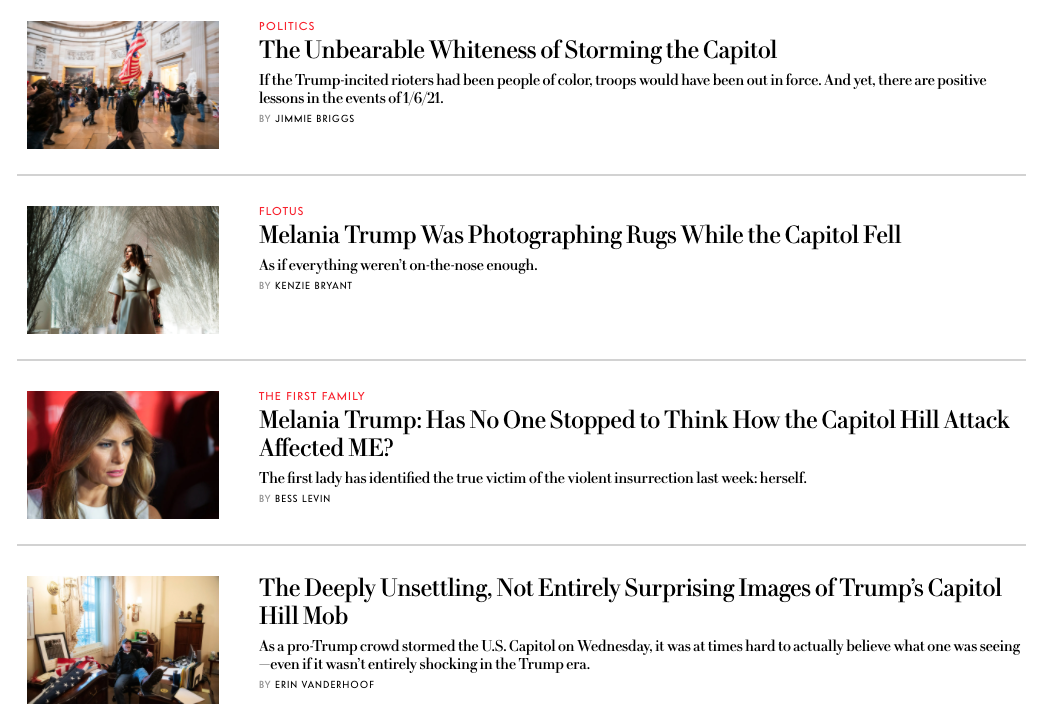
Vanity Fair published some of the sharpest criticism of the events of the 6th and of the former president. With a gorgeously acid tone even on the more “newsy” pieces, Vanity Fair presented the same information as many of the other outlets (Tweets from people on the ground, reporting on the mob’s timeline and behavior, indictment of Trump’s hand in the action) with a distinctly anti-Trump angle. The popup promoting an “inauguration sale”—get a subscription half off in time for the inauguration—highlighted the political identity of the outlet (and its commitment to riding the Trump Bump).
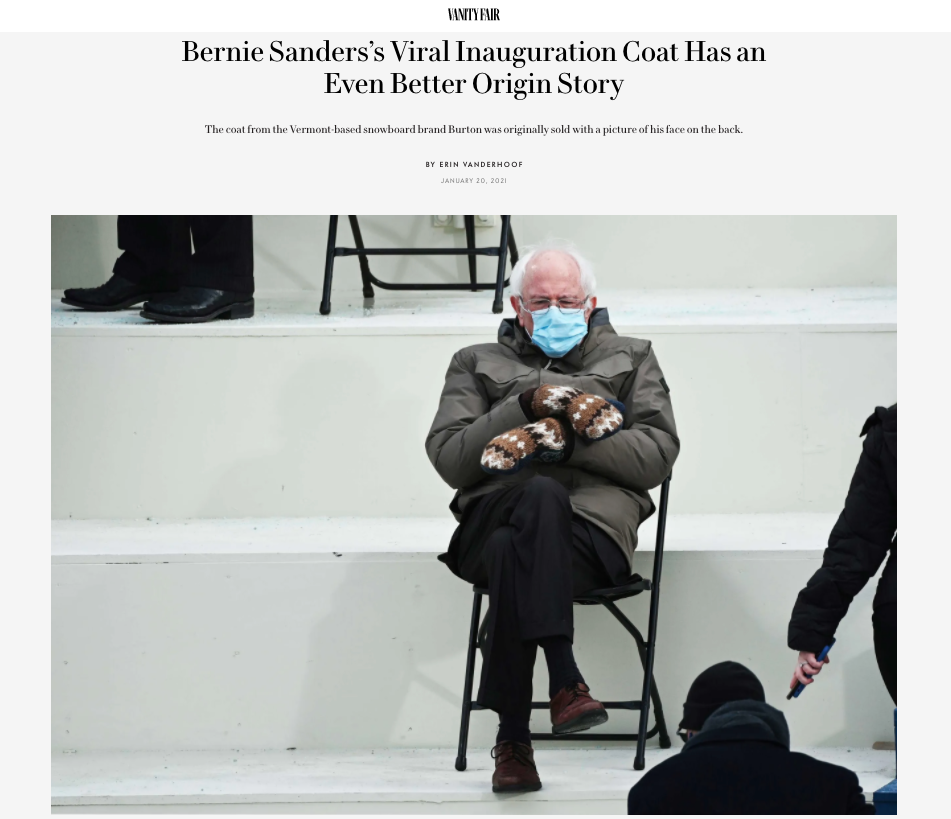
With its coverage of the inauguration, Vanity Fair focused more on culture than politics. While it offered reporting on the event itself and its political ramifications, much of the reporting centered on fashion, musical performances, and that viral Bernie Sanders photo.
The New Yorker
Like the New York Times, the New Yorker provided an easy navigation panel titled “The Transfer of Power,” with sections primarily addressing the fallout of the January 6 insurrection. Along with the op-eds and commentaries the New Yorker’s staff is known for, coverage of the insurrection also included an extensive report by a journalist who followed rioters into the Capitol featuring a particularly chilling moment when one rioter says to a police officer “this is so weird—like, you should be stopping us”.

Like its coverage of the insurrection, the New Yorker’s inauguration reporting featured primarily commentary by various columnists. Much of this addressed the problems facing Biden and the state of the United States going forward. But it also was notably heavy on the cultural elements—the fashion, the music, the poetry.
The Wall Street Journal
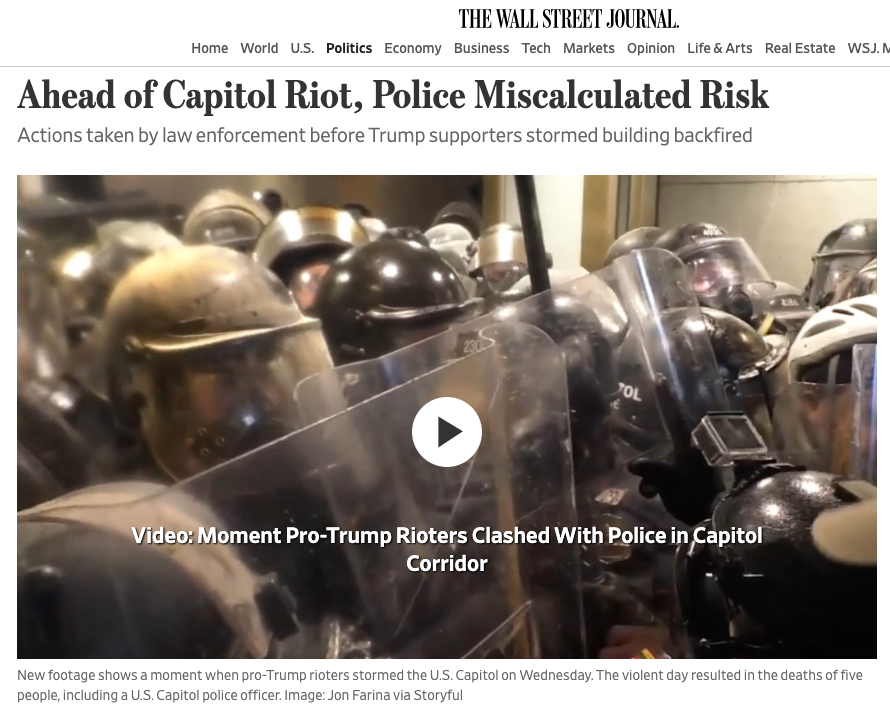
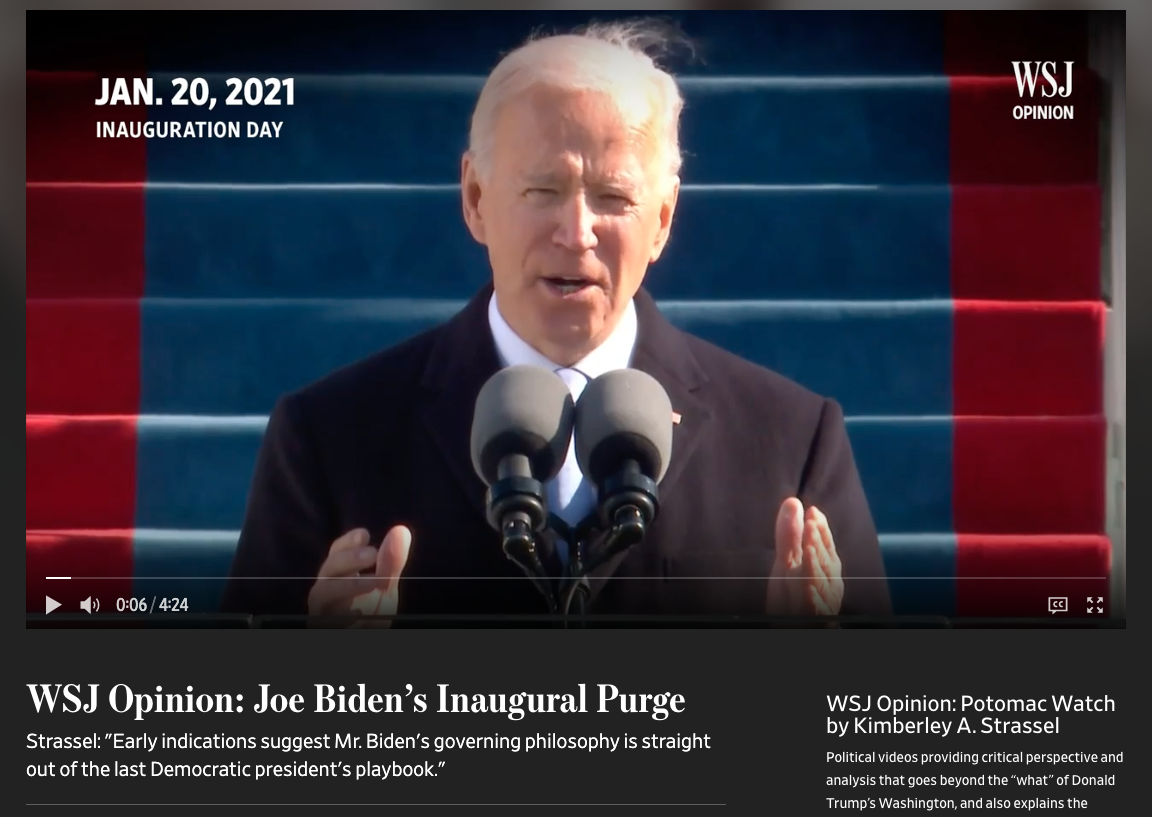
The Wall Street Journal had pieces on all the major beats—following one rioter’s experience, covering how Trump set the stage for the events to occur over months—but, expectedly, its reporting also had more emphasis on the economic consequences of the insurrection at the Capitol. In general, it offered fewer overall pieces related to the events of January 6 than other titles.
Unsurprisingly, the Wall Street Journal’s more conservative op-ed team offered several solidly Republican takes on Biden’s inauguration and presidency. Coverage of the event itself was limited to a discussion of how empty Washington, DC was.
Vogue
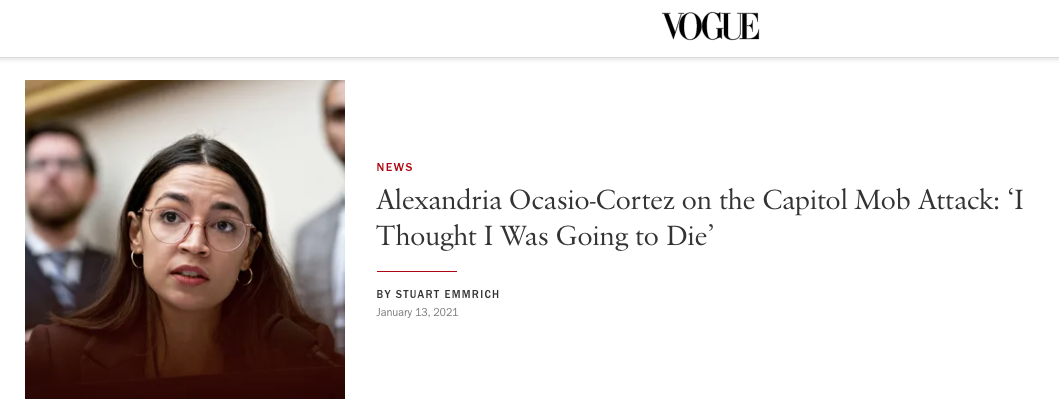
It’s a strange experience typing “capitol insurrection” into a search bar that auto-suggests “TRY ‘STREET STYLE.’” Vogue’s coverage of the riot at the capitol, in addition to themes shared by other outlets (photos of the chaos, the double standard when comparing police response to this summer’s response to the Black Lives Matter movement), was heavy on the reactions of powerful women to the events at the capitol. Articles featuring Amy Klobuchar, Alexandria Ocasio-Cortez, Tammy Duckworth—and Janaya Future Khan—offered a slightly lighter feeling than some of the traditional news outlets. In many ways, Vogue’s coverage of the insurrection felt like an article about anything else—fashion, makeup, shopping trends—with political content inserted.
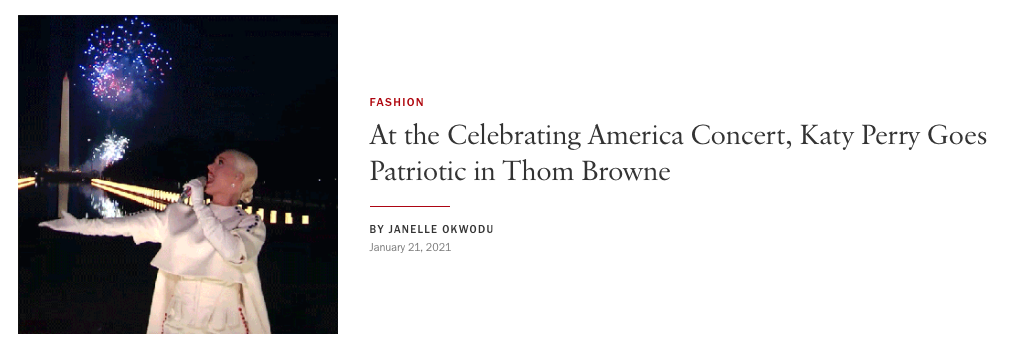
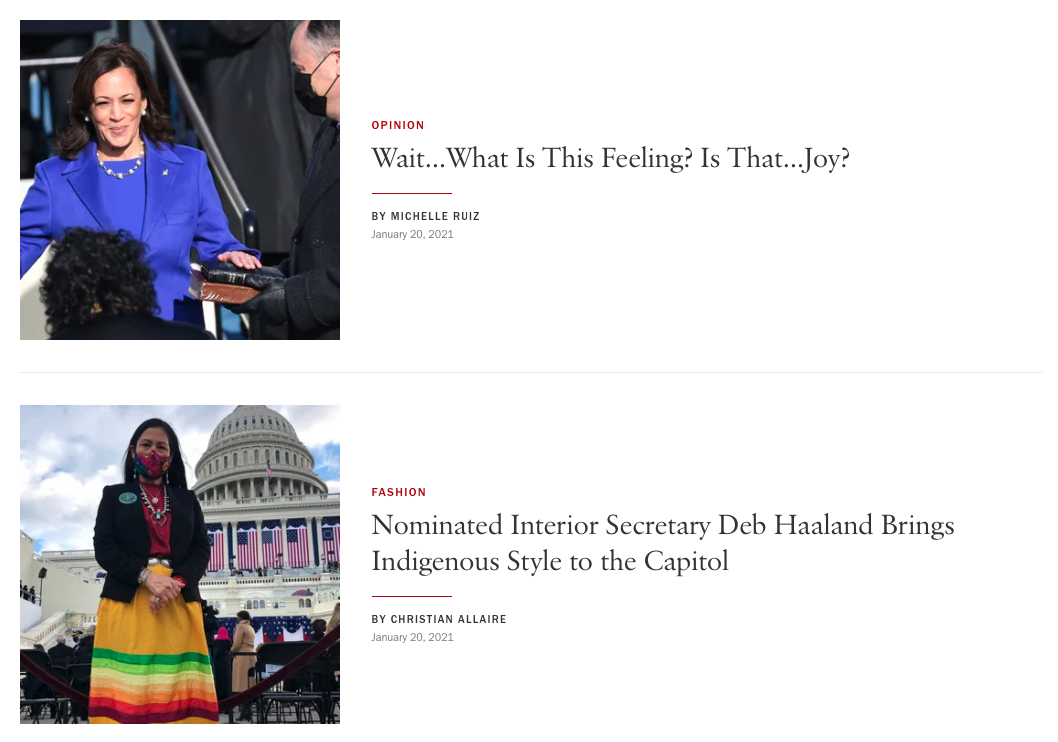
With the inauguration, Vogue was able to pivot back to its comfort zone. The delightful fashions of politicians, first ladies, and performers were all covered in depth, from the meaning of all the pearls to headbands inspired by Inaugural Poet Amanda Gorman’s look to, yes, Bernie’s mittens. Vogue did publish a few pieces on the political significance of the inauguration and a rundown of its events, but its reporting largely returned to the world of fashion.
Teen Vogue
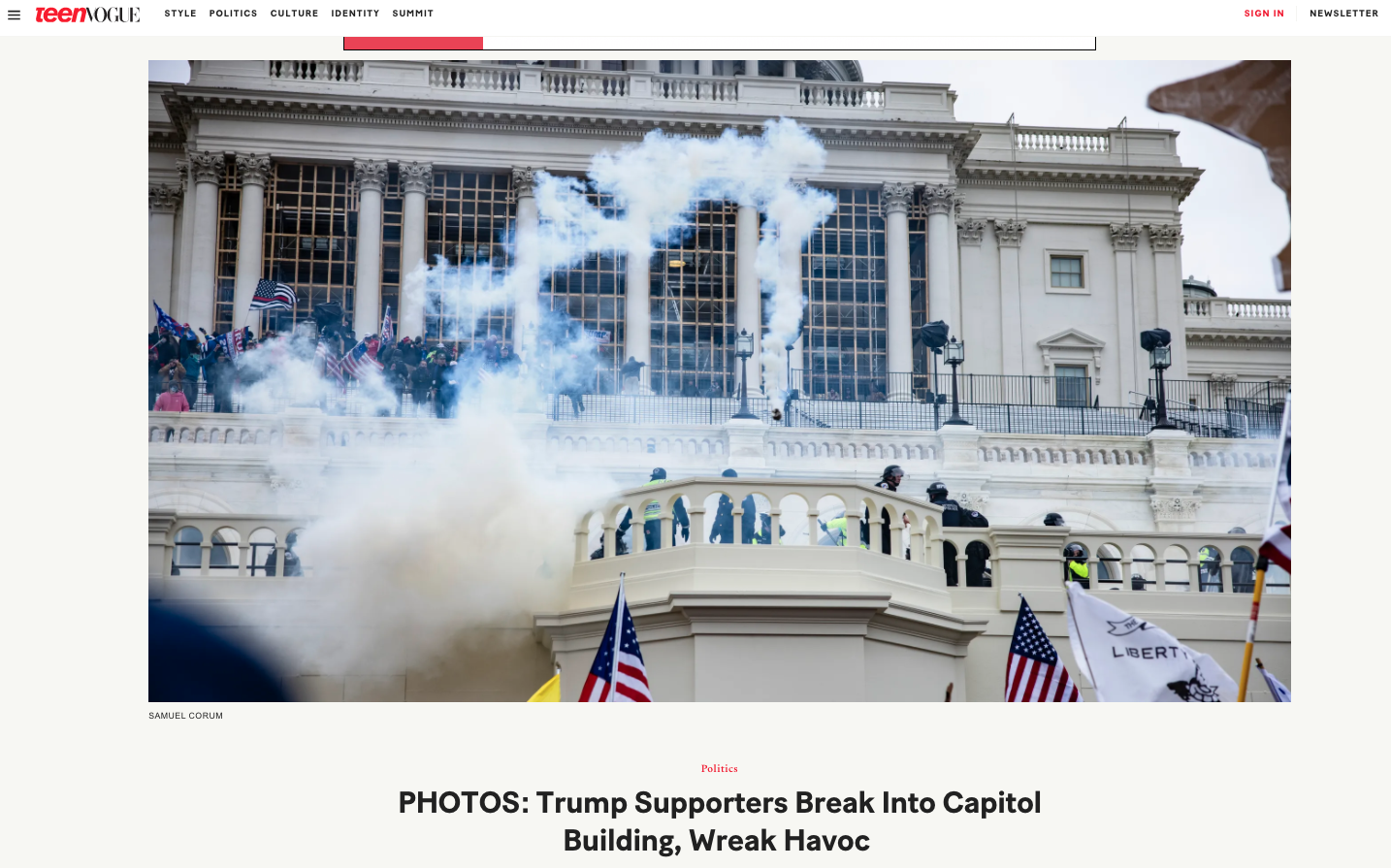
In recent years, Teen Vogue has become something of a liberal political powerhouse. Its coverage of the insurrection reflected this new role, aligning more with the New York Times than Vogue in content, though with a younger voice— “the photos [of the insurrection] are unreal,” Teen Vogue declares.
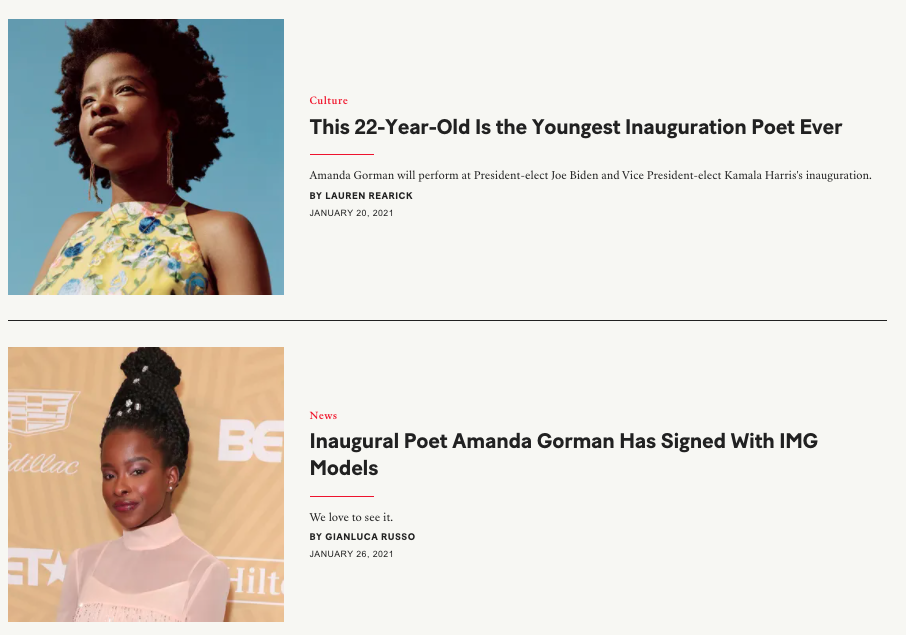
Its coverage of the inauguration, on the other hand, looked more like Vogue’s, featuring “your guide to the inauguration” and a basic summary of the events, alongside a slew of articles on the day’s fashion and makeup (and why everyone on the internet is so obsessed with the Biden granddaughters).
Slate
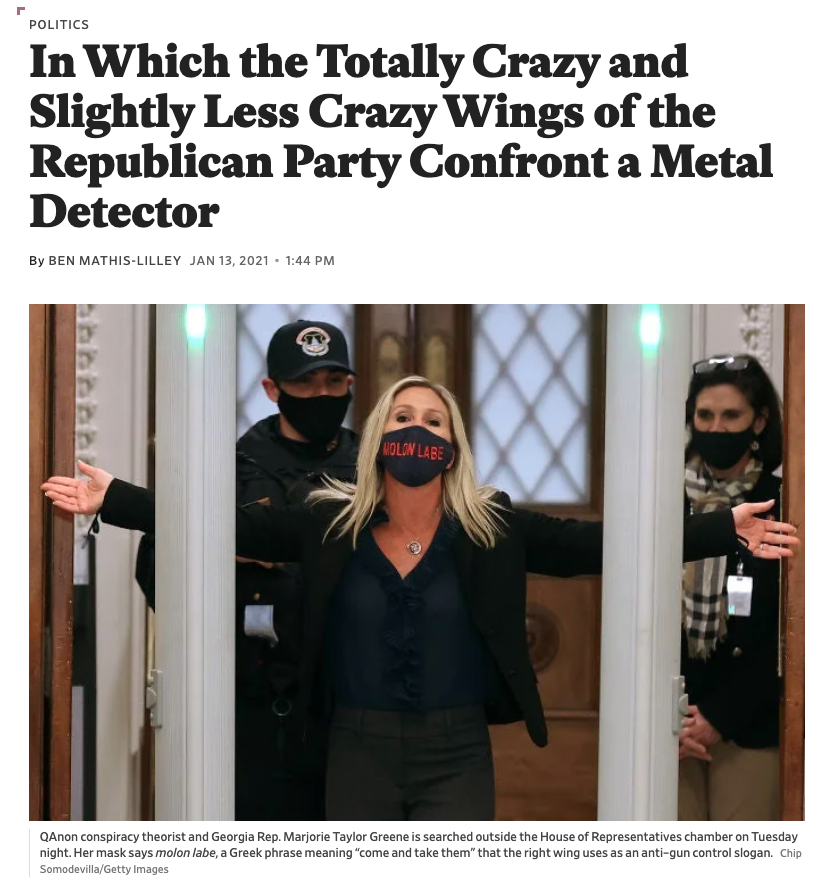
Slate’s reporting on the insurrection featured a number of pieces on various specifics (male rage, open carry laws, a sort of funny piece about a metal detector) in addition to general reporting on the event itself and a number of opinion pieces.
Slate had particularly comprehensive coverage of the inauguration, with pieces on Trump and Biden supporters’ feelings, respectively, as well as a live blog and many opinions. Its reporting, as with the insurrection, leans liberal and critical of Trump, to the point of almost laughing at him and his supporters.
Time Magazine Covers
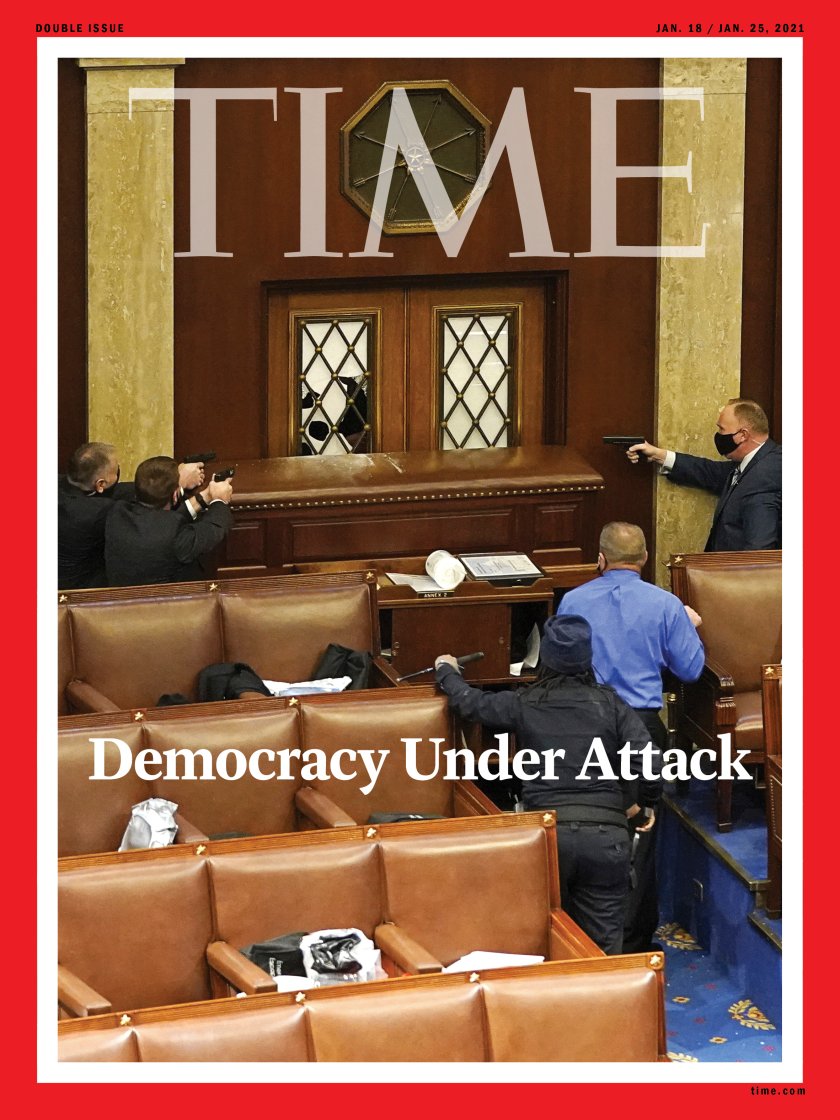
The Time cover for the week of the insurrection features a photo of capitol police aiming their guns at a door broken by rioters in the House. The image creates an urgency without giving space or voice to Trump supporters, their flags, or their agenda.
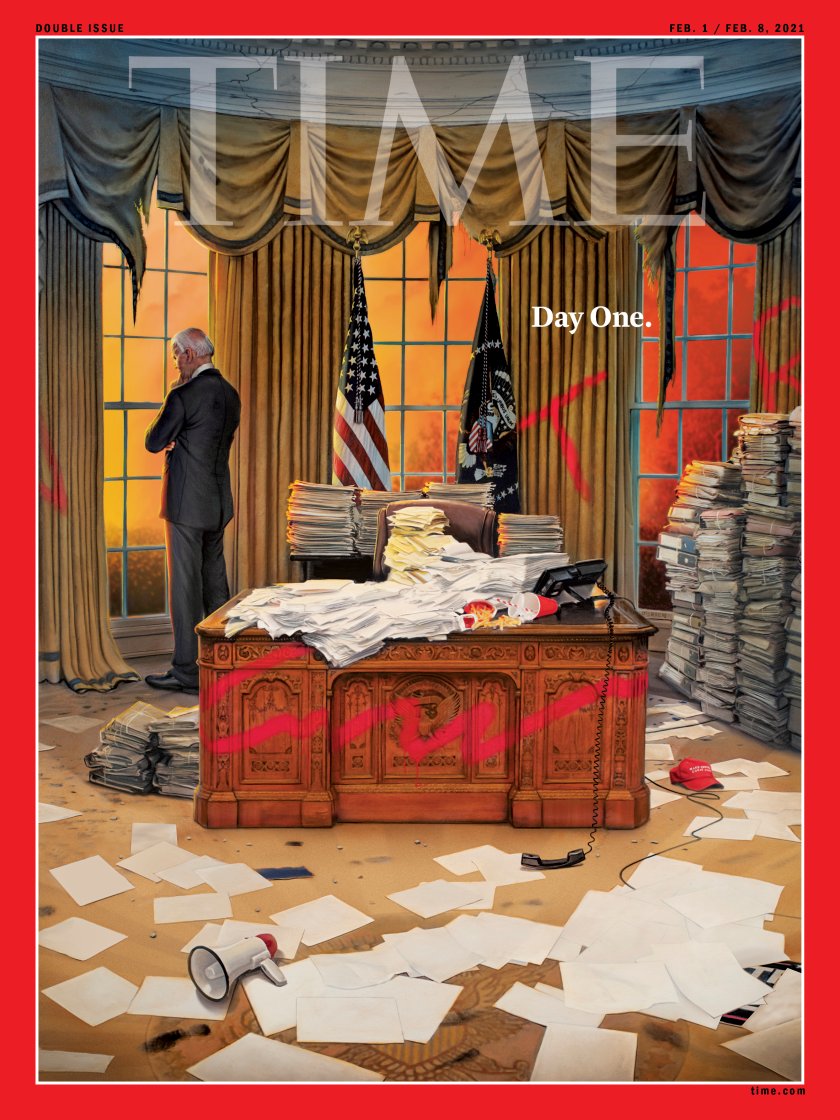
Its cover for the Biden inauguration is a painting of a thoughtful Biden standing in a completely trashed oval office, surrounded by a physical manifestation of Trump’s chaos. Graffiti covers the walls and the desk, papers and fast food wrappers are scattered around, the phone hangs off the hook. Biden looks contemplatively out the window at an orange sky, accompanied by the words “Day One.” This imagining of the literal and figurative mess Biden will have to clean up reflects much of the country’s concern and hope about the future of the nation.
National Geographic
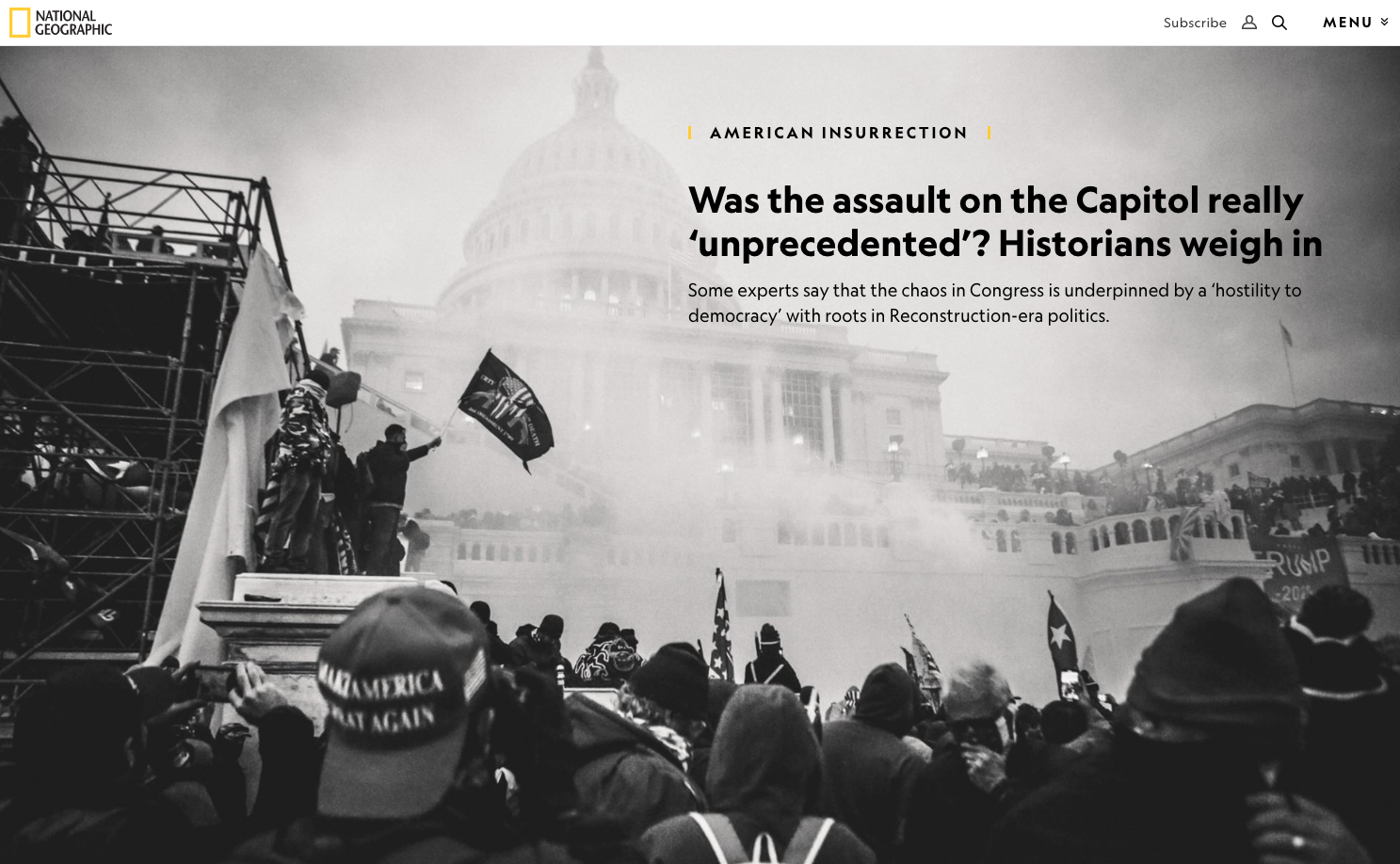
In addition to some basic coverage of the insurrection and the photos for which it’s maybe best known, National Geographic offered a historical angle and intellectual analysis of the events at the capitol, contextualizing them in the worlds of history and art. Articles explored “the resonance between the US Capitol’s masterpieces and the riots,” decoded the hate symbols seen at the insurrection, and looked at whether the events really were “unprecedented.”
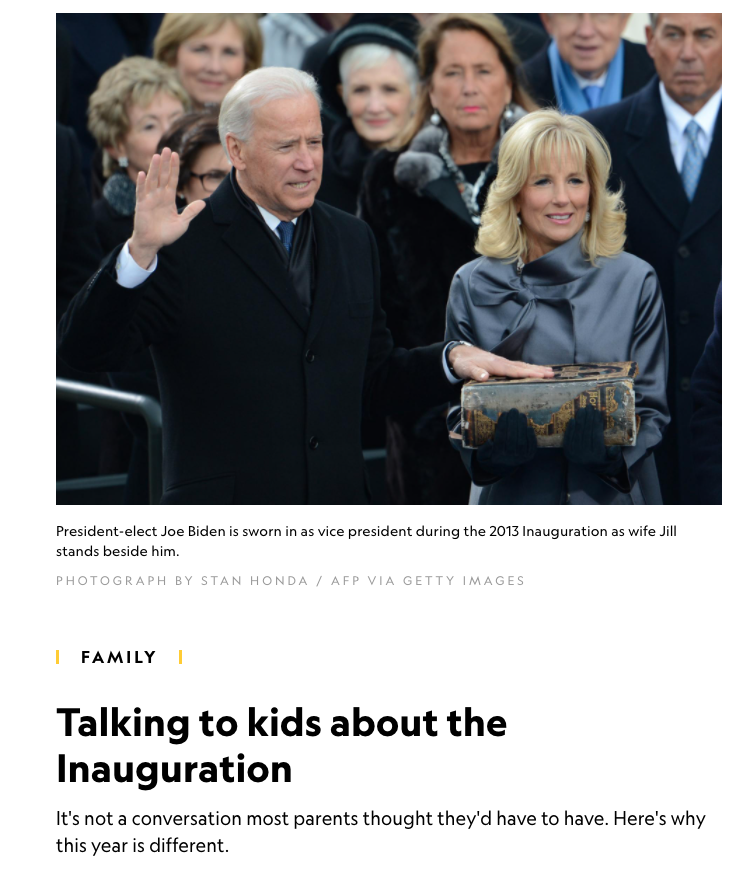
Its coverage of the inauguration used a similarly historical angle, but also featured information geared toward children and their parents to help kids understand the inauguration and its significance, offering a number of educational tools.
As Americans adjust to the new presidential administration and hope for a new political climate, our eyes will stay on the media to see if this trend might be the first sign of the “return to normal” Americans have longed for for four years. At the very least, it’s a relief to get to enjoy politicians’ fashion choices again.