Time for Trust: FIPP World Media Congress 2026 report launched
As the FIPP World Media Congress drew to a close in Madrid last month, it was abundantly clear that one word underpinned almost all the issues discussed at the event: Trust.
Whether it’s the faith readers have in publishers to be accurate, the confidence advertisers need to have in the audience they are buying or media companies knowing their terms will be respected when negotiating with tech companies, building and maintaining trust is crucial to the future success of the industry.
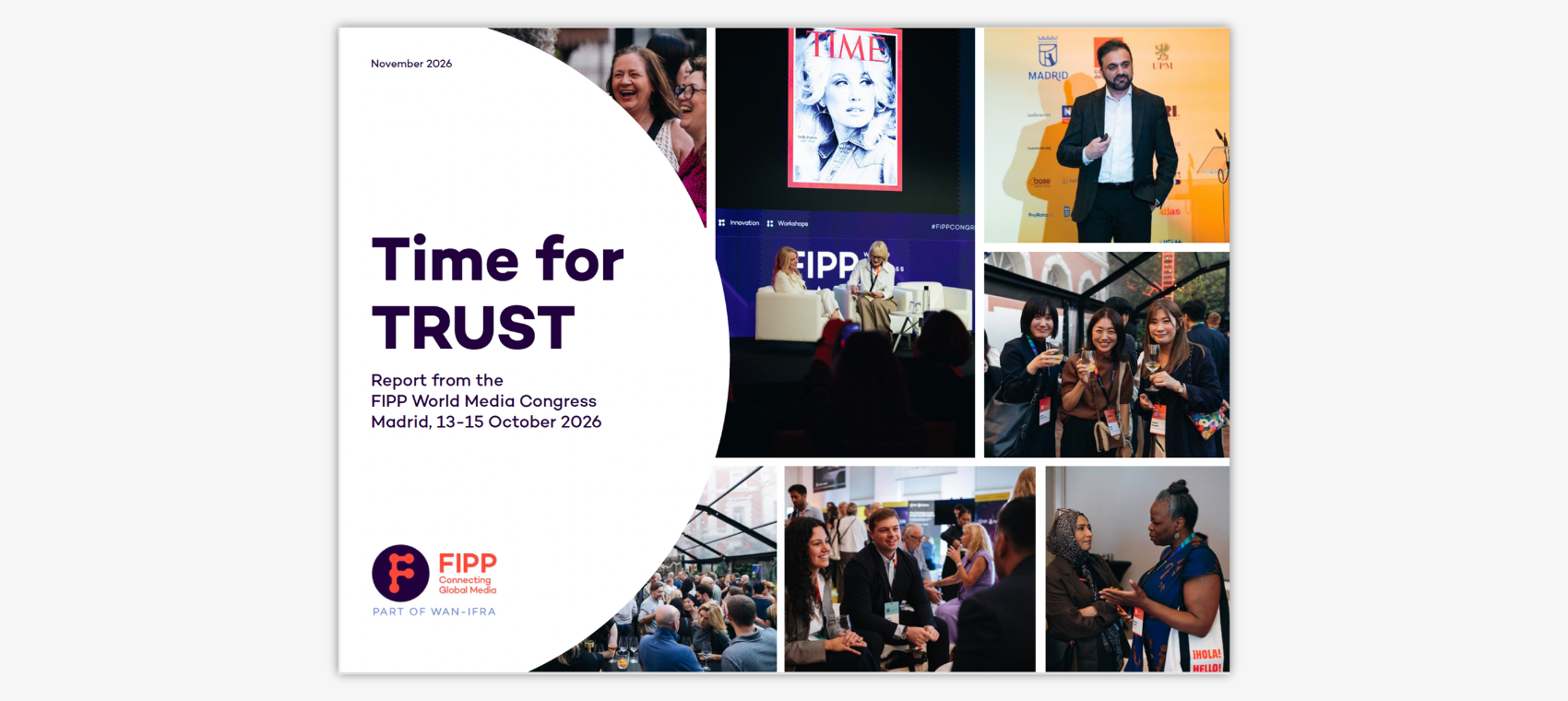
The FIPP World Media Congress report, released this week, reveals how the theme of trust was discussed and debated across the three days of the marquee event in the Spanish capital. In particular, the report – entitled Time for Trust – looks at how publishers can bridge the gap between the value people recognise in journalism and the return publishers actually capture.
“What gives me confidence is how Congress approached that challenge,” Alastair Lewis, Chief Commercial Officer, WAN-IFRA, points out in the report’s foreword.
“Speakers did not offer a single answer. They offered choices: build around an audience you understand with focus, make authorised access a service people want to buy, earn a place in readers’ routines, give teams the authority to deliver, and be willing to stop what no longer serves the strategy.”
Across seven chapters, the report explores hot-button topics including licensing, attribution and bargaining power in publishers’ dealings with AI companies; turning passing attention into lasting audience relationships; the journalism, products and experiences audiences choose to support; and building common ground without surrendering competitive identity.
Insights are backed up by a number of case studies from publishers including Harvard Business Review, People Inc., Storytime Magazine, The Kyiv Independent, AgriMedia and RBA.
Trust and the value gap
Congress showed how publishers can earn confidence in their journalism while struggling to turn that faith into a sustainable business. In fact, while reporting may be respected, expertise valued and information widely used, media organisations may capture only a fraction of the benefit.
In her talk The Trust Economy, Media Consultant and Board Advisor Linda Thomas Brooks pointed out that editorial expertise alone could not earn an audience’s confidence. She placed competence alongside the reader’s perception of the publisher’s intentions, with people wanting to know whether the business cared about their interests.
According to Brooks, transparency about how stories were produced and how audience data was used are crucial. She also urged editorial organisations to be clear about how they’ll explain and address mistakes before they happen.
Something else confidence in journalism does not settle, are the arrangements through which those who produce it earn money.
In the session Getting Paid in the Age of Answer Engines, Jonathan Roberts, Chief Innovation Officer at People Inc. stressed that companies urgently need to take control of who can access their information, and on what terms, to cash in on the ever-expanding AI information market.
People Inc. has adopted a three-pronged strategy when it comes to AI partnerships: block unauthorised access, negotiate payment and build better services for legitimate commercial partners.
“There is an explosion of need for content in this new AI world, and just like everybody understands magazine distribution, everyone understands search,” he said.
“There’s a 100 times bigger search market getting built today, and nobody owns it. It’s a wide-open field for a huge new search market. We know how valuable those are, and that’s only if you ask new, different, more interesting, more nuanced, more specific, more niche questions than you ever had before, which means not only is there more demand, but we need new supply.”
Publishers have greater control over the relationship when people choose their products deliberately. Earning that choice requires a clear understanding of what the audience wants to accomplish.
In Building a Robust Media Ecosystem: Thriving Through Technological, Geopolitical, and Market Shocks, Christian van Thillo, Executive Chairman of DPG Media, talked about shifting his company’s focus from digital transformation towards creating greater value through its digital products.
This includes moving customers into a different format and developing benefits that justified a more valuable relationship.
Injecting trust into AI negotiations
Apart from trust, the biggest talking point at Congress 2026 was, of course, the rise of AI. The two topics converge when it comes to negotiations between publishers and tech companies with publishers needing confidence that partners will respect permissions, and buyers needing confidence publishers can supply the material and rights they offer. Both need arrangements sufficiently clear to support investment.
The debate in Madrid exposed the work still required to establish those relationships – and the difficulty of doing so when the parties have very different incentives.
When it comes to negotiating power, a publisher has less leverage when a prospective customer can obtain the same material without entering an agreement. Controlling access therefore has a commercial purpose as well as a protective one.
In Getting Paid in the Age of Answer Engines, Jonathan Roberts laid out a strategy combining restrictions on unauthorised automated access with services for approved partners. Permission became something the publisher could offer within a defined commercial relationship.
Congress underlined how trust cannot remove unequal bargaining power or substitute for terms that can be enforced. Making that distinction explicit, Van Thillo called for enforceable legislation governing publishers’ dealings with technology companies and remuneration.
During Making the Rules Stick: Aligning Publishers, Platforms and Politics, former Australian communications minister Paul Fletcher discussed government intervention in an interview with Ricky Sutton of Future Media.
Taking delegates behind the scenes at Australia’s News Media Bargaining Code, he described an attempt to change the conditions surrounding negotiations between news businesses and digital platforms.
The precedent concerns a particular regulatory framework and relationship. While it
does not supply a complete settlement for generative AI, it allows individual negotiations to take place within conditions governments can influence.
Ultimately, when it comes to publisher/tech negotiations, publishers need clarity about permitted uses, payment arrangements and how compliance will be established, while buyers need confidence that suppliers hold the rights they offer and can deliver the promised service.
Participants in shared arrangements need to understand how decisions are made and how their interests are represented.
Earning the return
During his talk The New Front Door: Where You’ll Find Your Users Next, Michael Brunt, co-founder of HBM Advisory and a former general manager of The Times and The Sunday Times, argued that publishers had become accomplished at measuring how people arrived while giving insufficient attention to what happened afterwards.
Aptly, he compared it to a journey to Madrid: the value lay in the experience after arrival, rather than the details of the airport and baggage carousel.
Brunt urged publishers to treat an article as an introduction to the product. Someone who finds a useful explanation should be able to recognise who provided it and see a relevant next step. That might be another piece of reporting, an ongoing series or a newsletter serving the same interest.
Brunt gave the example of an unnamed newspaper client whose article pages gave prominent space to paid links leading elsewhere. Links to its own journalism were less conspicuous. The arrangement generated some advertising income while directing people away from the publication.
The case study exposed a choice that can be obscured when different teams optimise different measures: the immediate return from an exit can compete with the opportunity to develop a reader relationship.
The answer is not to expect every visitor to subscribe or to obstruct someone who has found what they need, but to remove avoidable dead ends.
Learning lessons
Bringing trust and engagement into sharp focus, the Congress report turns to children’s publishing.
In Stop Selling Magazines, Start Building Audiences: Kids Trusted Media Initiative, Lulu Skantze, founder of Storytime Magazine, described how discussions about cover gifts could displace attention from the stories inside a magazine.
She recalled a meeting in which the success of an issue carrying several gifts led to a debate about adding another. The product was being shaped around the inducement to buy rather than the reading experience it offered.
To combat this, Skantze has put the development of readers at the centre of the business. Children need engaging material, opportunities to encounter it and time to discover what they enjoy.
Skantze described Storytime’s approach across formats, with print at its heart, and discussed routes to readers through families, schools and partnerships. Those routes require confidence from adults as well as enthusiasm from children.
Speaking in the same session, FIPP chair Yulia Boyle outlined the new Initiative for Kids Trusted Media launched through FIPP and WAN-IFRA that aims to make trustworthy media a meaningful part of every child’s life.
Its proposed activities included a recognisable quality seal, connections with buyers and funders, and research into children’s magazine media across formats.
“What if we stop valuing the monthly value of a subscriber and decide to consider the lifetime value of the subscribers we are raising?” asked Skantze, who chairs the Kids Trusted Media Initiative. “How are the kids we are serving now going to become the adult customers of your products when they grow up? How would they know what a magazine is if they have never seen one?”
Goats, winemaking and a towering success
While a new product can give a publisher a promising source of income, it comes with obligations: someone must produce it, sell it, support its customers and decide how it fits with everything else the business offers.
As Congress showed, the success of growing a brand is a question of trust inside the business as well as trust between publisher and audience.
In the session Beyond Publishing: Building Agricultural Communities, Jean-Paul Reparon, managing director of the Dutch specialist publisher AgriMedia, revealed how the company had acquired a small wine-growing publication and was developing an editorial service for growers in the Netherlands and Belgium.
Its ambition extended from the magazine into events, research relationships and opportunities for professionals to meet.
“Everything we do at AgriMedia at is about our mission – knowledge that enriches you,” he said. “That’s what we do as a business-to-business publisher.
“We are publishing in the arable farming, dairy farming, goat breeding, milking and winemaking area. We have a small event about exotics coming from outside, and then we talk about plants and the problems they have in open green maintenance.
“And a special word for the National Goat Event, attended by 1,000 people and 200 goats. We hand out an award for the most beautiful goat of the year.”
The lesson lies in the progression. AgriMedia began with specialist content, invested in relevant expertise and developed other ways to serve a community it was getting to know.
Congress also showed how an ambitious piece of journalism can support several products, but only if the organisation plans for the work each one requires. This was underlined by Alex Poderoso, digital director of RBA Revistas, in the session Talent and Technology: How RBA Grows Reach and Impact to Lead in Print and Digital.
He revealed how National Geographic’s coverage of the Sagrada Família’s crowning in Barcelona brought together reporting, specialist access, photography, illustration and video around a substantial editorial undertaking.
“We exceeded print sales expectations of the physical issue, we recorded historic traffic peaks on the website with the content, and we gained more newsletter subscribers,” Poderoso said.
“We also significantly increased the advertising revenue thanks to the brands that were interested in associating with this milestone.”
“We recorded a huge number of new paid subscribers attracted by exclusive multimedia content that we have. And beyond the numbers, we think that we reinforced the prestige of National Geographic.”
You can download the full Congress report here.