What’s up Down Under: Vahe Arabian, the founder of State of Digital Publishing, shares his thoughts on the fast-changing media landscape in Australia
Whether it’s the Covid-enforced cull of iconic print magazines or a landmark law requiring Google and Facebook to pay local outlets for news, the Australian media industry has undergone seismic changes over last few years.
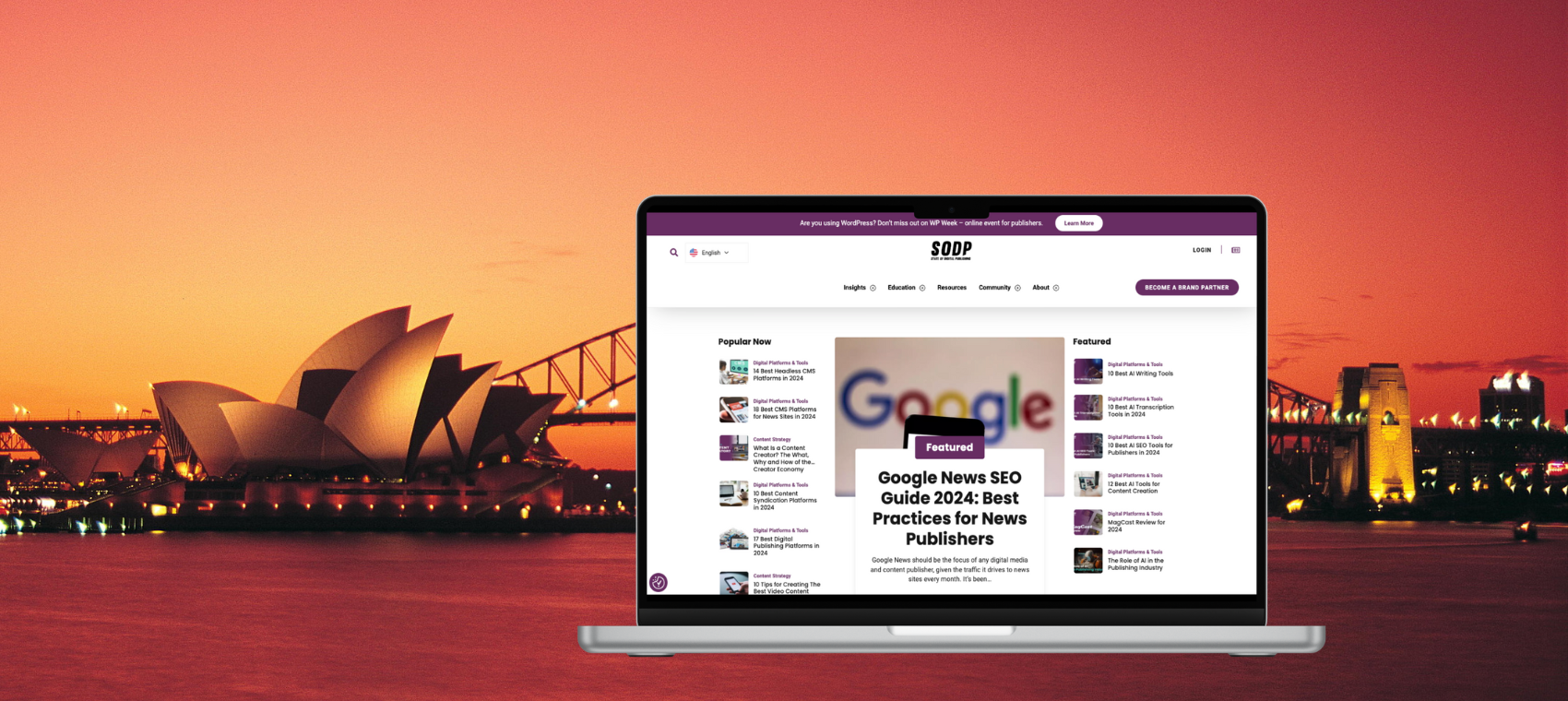
And the shockwaves are set to continue with many of the News Media Bargaining Code deals struck with big tech companies in 2021 up for renewal early in 2024. Guiding those in the industry through the rapidly changing landscape is State of Digital Publishing (SODP), a community and knowledge platform that create reviews, educational content, online events and research that help digital media publishers and editorial marketing professionals develop their skills, gain stronger insights and grow their audience.
As FIPP begins a new content sharing partnership with SODP, we catch up with its founder and Editor-in-Chief Vahe Arabian to talk about the current state of digital publishing Down Under, the rise of AI and how digital publishers in Australia are pulling together to negotiate some challenging and exciting times ahead.

What does the media landscape look like in Australia after a few tumultuous years?
A renaissance began for hyperlocal and independent publishers when the Media Bargaining Code was revised, stipulating revenue-sharing deals for publishers’ news content used amongst tech platforms Google and Facebook. Publishers also received funding from the Australian government. Greater representations via advocacy groups have led to training and expediency in the digital transformation of publisher operations. However, compared to the US, public interest journalism is not yet recognised as a charitable good despite widespread support from industry in both media and philanthropic communities.
As the media landscape evolves, a renewed focus on the News Media Bargaining Code deals will appear to have a broader application across more tech platforms and oversight, factoring AI and a growing basket of local media and individual creator-led initiatives.
What are the main media trends you are seeing in Australia?
Despite the shrinkage of ad revenue available to publishers, the underlying theme I am seeing is the premiumisation of the user. This essentially means we can maximise the return and perceived value of the connection made with your audience in three ways: Firstly, local linear offerings – with publishers selling their personalised offerings to advertisers across video, magazines, original podcast deep dives and so forth from more local content that can drive more user engagement and conversion. Secondly, an increase in messaging via apps usage such as Facebook Messenger and WhatsApp and user-generated content could lead to new community-building and event-driven opportunities and experiences. And then through more product-led recommendations from publishers as a ‘trusted voice’ and conduit between brands and end-users. Also, much of the misinformation concerns and shift in the industry due to AI taking place globally applies to Australia. As a result, there is a need to raise the profile on more best practice examples to encourage further innovation and automation in the local landscape.

What would you say are the biggest challenges facing digital publishers, in Australia and globally?
There are quite a few challenges facing digital publishers but perhaps the most prominent ones are the commoditisation of content, determining the ultimate mix of monetisation models and cutting through the tech noise.
Ok, let’s start with commoditisation of content.
AI and ML-enabled tools are on the rise. While they hold great potential in helping publishers optimise and automate numerous processes, they are also changing the industry’s landscape when it comes to creating content. The ability to stand out in an increasingly crowded market – one where a single individual can generate hundreds of posts using AI writing tools – and keep the audience engaged by showing the value of the content are on the minds of every publisher in Australia and around the world.
Could you expand on the challenges when it comes to determining the ultimate mix of monetisation models?
Most publishers try to set up multiple revenue channels. It’s a smart approach, of course. You don’t want to depend on a single source of revenue. However, many struggle with identifying the right blend and the balance between various monetisation models. You have subscriptions, ad revenue, sponsored pieces, etc. Many are dipping their toes in the events space. I’ve seen many publishers lose a big chunk of their audience when they introduced the subscription model to supplement their advertising revenue. And many other scenarios like this one – introducing a new revenue channel only to realise that directly or indirectly, it’s negatively impacting another monetisation channel.
And what about cutting through the tech noise?
This is largely tied to the massive hype around AI-enabled technologies in the last year or so, but not exclusively. The tech market is massive. It’s crowded. It’s noisy. Publishers often struggle with FOMO: “If we don’t introduce this new piece of tech that all our competitors seem to be embracing, will we be missing out?” While there are many case studies about publishers integrating new tech with amazing results, it really is a struggle to find a needle in the haystack – identify just a few tools that will help optimise processes as opposed to distract teams and create unnecessary time and money burdens.
How important is it in these challenging times that digital publishers are a tight-knit community who can communicate and learn from one another?
With content getting increasingly commoditised and the rise of AI-enabled tools, it’s more important than ever for publishers to engage with each other in a community setting. While there is always going to be competition among digital publishers, they share a great deal of common challenges: how to keep their audiences engaged given the abundance of information available to them at their fingertips, how to develop sustainable business models, how to combat the spread of misinformation – just to name a few. Being a part of a community will enable publishers to identify strategies to move forward in the age of rapidly changing readers’ needs and preferences.
The SODP website features many interesting stories about artificial intelligence. How are you helping your community cope with the rise of AI?
2023 was a big year for AI. At SODP, our community received many questions and thoughts on this subject. That’s a big reason we paid special attention to it. In November/December of 2023, we ran an AI Month, where we ran articles on the best AI tools on the market, interviewed experts, provided how-to guides, etc. We addressed this topic at PubTech2023 – an online event we hosted at the end of November for our community of publishers. We are also dedicating a session to it at the end of February during the upcoming WP Publisher Success Week.
What were the main takeaways from all these activities, research and conversations with your community members?
It’s too early in this technology’s development cycle to place all eggs in one basket. There is still a lot of uncertainty about the best way to integrate AI into the content creation aspect of publishing. We’ve all read stories about major publishers like The Guardian, The New York Times, and others creating and revising their AI policies. We’ve read stories of publishers getting caught in the scandal of generating pieces using AI. The market is simply not stable enough, and the future is not clear enough for publishers to fully commit to a specific AI strategy. Instead, I recommend minimising risks through micro experiments – integrating one tool at a time in a limited environment, testing it out, and scaling it up or eliminating depending on diligently measured results. Process optimisation is currently the safest bet and biggest opportunity for publishers when it comes to riding the AI wave. AI-enabled tech should be seen as tools that aid humans, not tools that replace humans or processes. For example, an AI tool shouldn’t be used to write an entire article. However, it can be used to gather information on keywords, analyse the piece for SEO, provide ideas on relevant follow-up pieces, etc. Integrating AI tools to improve and optimise processes will not only help publishers achieve stronger efficiencies but elevate the skills of their staff. For example, newsrooms can get a better understanding of integrating best SEO practices in their work.
Could you tell us a bit more about your Publisher SEO courses? How important is education in the SODP business strategy?
Education is at the foundation of our work. My background is in SEO. I’ve worked with many publishers on optimising their content and SEO strategies before I founded SODP. And that’s a big reason I started SODP in the first place – the industry has a unique blend of challenges and needs that can’t be addressed with generic best practices. It’s true when it comes to SEO, setting up monetization models, creating and optimising tech stacks, and so on. At SODP, we want to bring our readers the most relevant information – be it in the form of tips, how-to guides, online events, educational courses, roundup pieces, etc. Having a community of publishers, as discussed earlier, helps us identify topics and the specific questions around those topics that publishers struggle with. That’s how the Publisher SEO course came to be. We saw many publishers struggle to see meaningful results from their extensive SEO work. Why? Because they were going off advice that’s not tailored to the publishing and news industry. While there are many excellent SEO resources out there (courses, guides, consultancies), if not customised to the needs of publishers, they will fail to produce the desired results. In addition, many smaller publishers were support that wasn’t financially out of reach and also practical to take the steps on their own accord. And so, we wanted to make this as accessible as possible.
Looking ahead, how positive are you about the state of digital publishing?
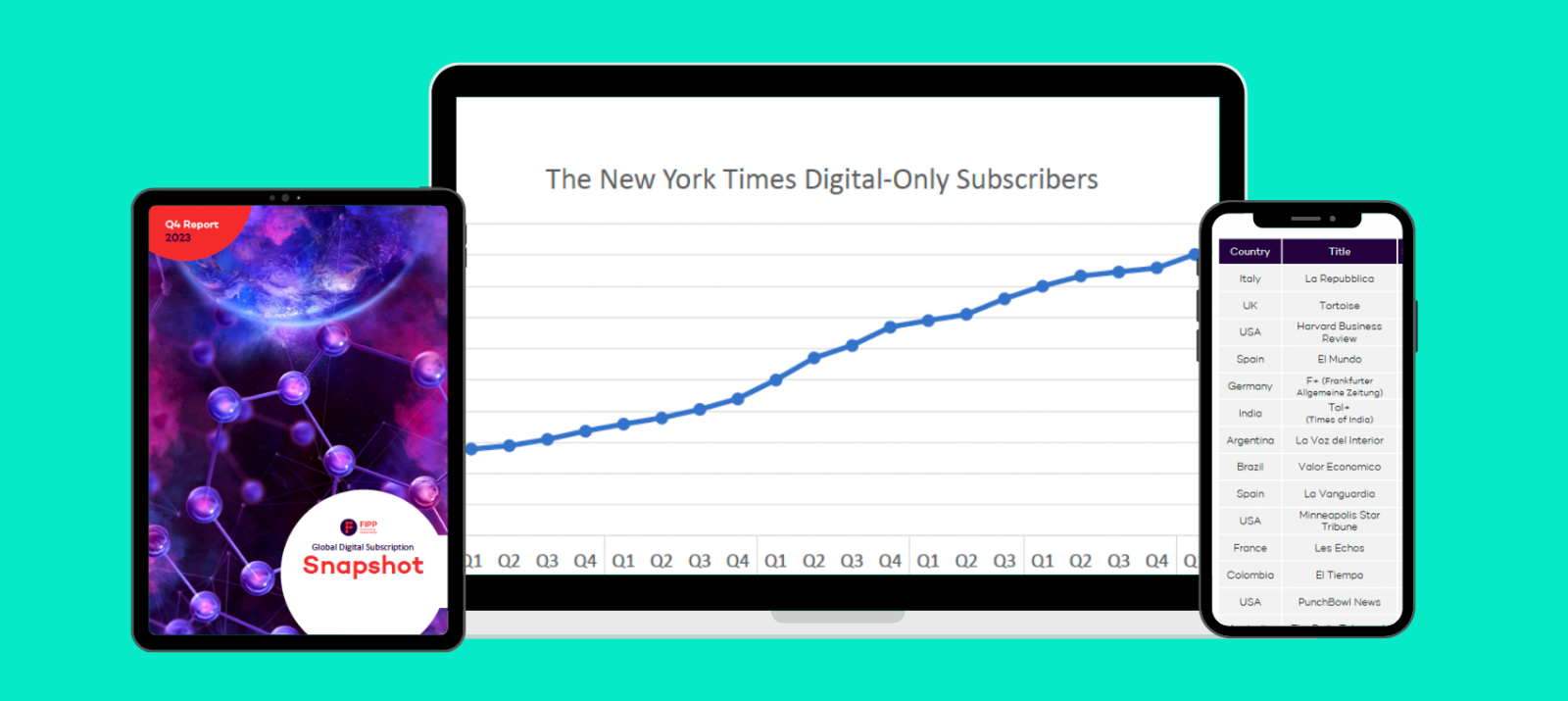
I am very positive about the state of digital publishing looking ahead. Yes, if you look at the micro trends, the industry has experienced many shocks and downward trends. FIPP publishes a quarterly report on the state of the global digital subscription market, so it can attest to the many ups and downs the industry has been going through. And if you look at them individually, dozens of other indicators will show foundational changes in the market.
However, looking at the macro trends, looking ahead, I see the industry growing and evolving as a whole. Once the dust settles, publishers will start ripping the massive rewards of AI-enabled technologies in optimising processes. I see publishers adjusting their strategies to give individuals within their newsrooms a stronger voice and foster audience engagement and loyalty. I believe publishers will be able to develop agile growth strategies that change in parallel with the changes in readers’ behaviour. While I’m not a big fan of the saying “What doesn’t kill you makes you stronger”, looking ahead, I see it being the case for publishers.