Innovation in magazines in the spotlight at FIPP Insider Marseille
From strategies to build lifelong readers to luxury trends and ways to effectively tap into the question economy, FIPP’s latest Insider event, held in the beguiling French port city of Marseille in June, turned its focus to innovation in magazines.
Forming part of Wan-Ifra’s 77th World News Media Congress, the programme featured a line-up of compelling speakers including Lulu Skantze, co-founder and Editorial Director of Storytime Magazine; James Carter, Revenue Lead UK/EMEA at MonetizationOS; Paul MacDonald, co-founder at RealTimes Publishing Network; and Nicia Rodwell, International Brand Director at Marie Claire.
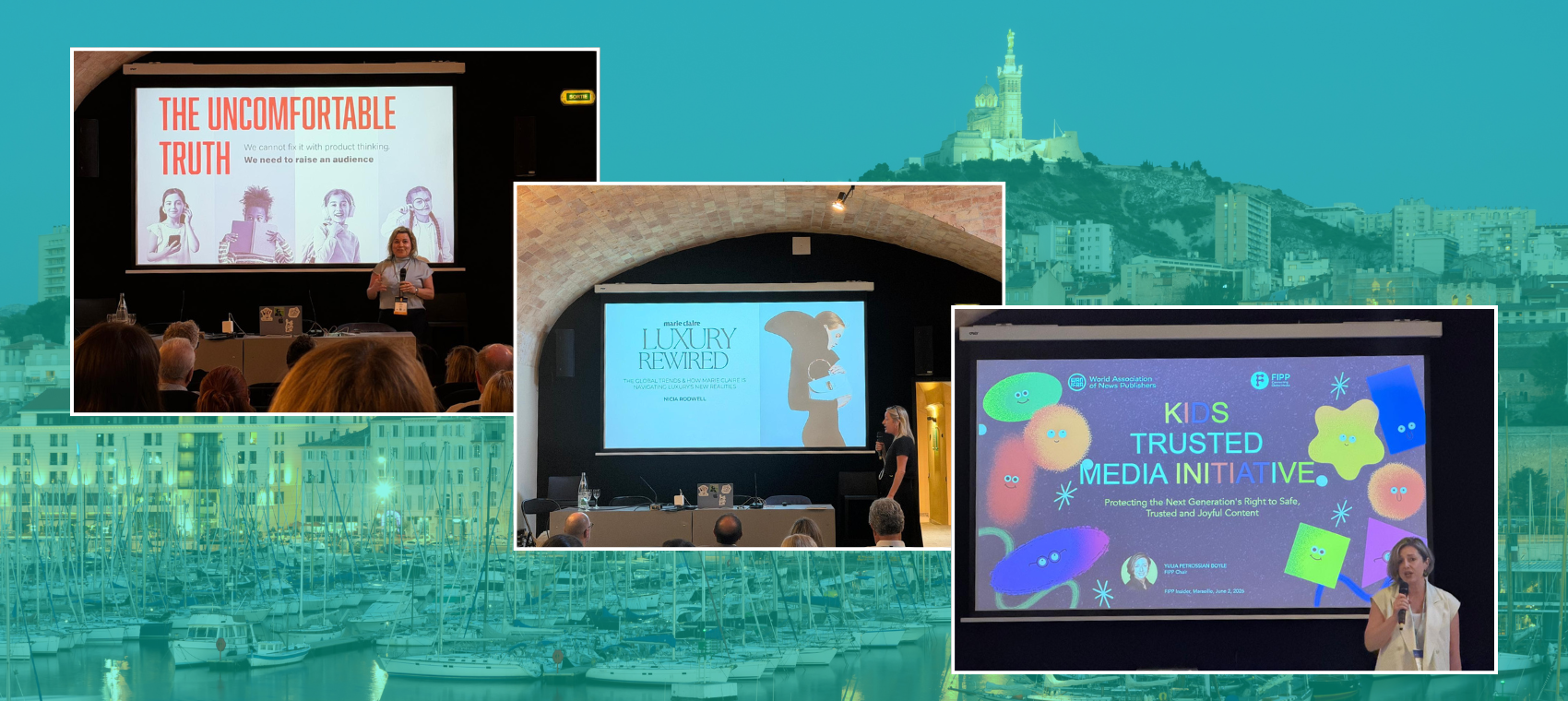
FIPP Insider Marseille, sponsored by MonetizationOS, also saw the launch of the FIPP Initiative for Kids Trusted Media, an initiative to establish industry standards for children’s media spearheaded by Yulia Boyle, Chair of the FIPP Advisory Board.
Meanwhile, Carter and MacDonald explored how digital publishers can respond to the increasing fragmentation of human audiences and the rise of machine traffic.
The event concluded with a discussion between FIPP CEO Alastair Lewis, Josh Freeman, SVP of Partnerships at ProRata, and Alice Ting, VP & Director of Content Licensing, DMG Media, looking at how, in Gen AI, questions are the new currency.
As with all Insider events, the programme was designed to facilitate knowledge sharing and networking opportunities, within and between national media markets around the world.
Stop selling magazines, start building audiences
In her talk, Lulu Skantze warned against magazine’s adopting a product-first mindset and explored how connected experiences across print, audio, digital and education builds lifelong readers and future-proofs revenue.
She pointed to a number of stats and facts showing that there’s a trust, demand and need among readers for closer a relationship with a print publication.
For instance, over 80% of readers trust print more than digital with young people seeking offline experiences. Meanwhile, education is returning to print, and parents are concerned about safety and quality when it comes to online content.
Skantze stressed that, when reaching out to young readers, “access is layered and trust is the filter.” The audiences that need to be won over are gatekeepers like families, NGOs and education who provide approval and children who fall in love with magazines.
According to Skantze, there has been a shift in business models in children’s media from a product mindset and one revenue stream to a new “LEGO Model” with an ecosystem mindset, multiple revenue streams and partnerships for growth.
Skantze reminded delegates that, when it comes to young readers, the “bigger the opportunity, the greater the responsibility”.
However, building ecosystems across print, audio, education, live experiences, licensing, community and safe digital products ultimately leads to a stronger industry, she added.
Staying on trend
Nicia Rodwell, International Brand Director at Marie Claire, took delegates behind the scenes at the style bible, showing how it’s responding to luxury trends in fashion and magazines.
She revealed how luxury and aspiration fatigue is driving a shift toward community and a more grounded “real life” human connection.
According to the Business of Fashion (BoF) and McKinsey’s State of Fashion 2026 report: “Consumers now demand products and experiences that nurture mind, body, and identity. Wellness and a feeling of ritual is central to shopping decisions, and luxury brands that have this emotional connection in their offerings will win loyalty and relevance.”
Research shows that solo living is rising rapidly (especially in Asia-Pacific), with a third of households in many rich countries now one‐person homes. And the share keeps rising bringing with it greater independence, but also feelings of loneliness.
In response, Gen Z is increasingly turning to slower, soothing content, comfort and self-care on social platforms. This growing appetite for “calm” is creating an opportunity for brands.
Increasingly, readers are craving human-first, tactile over polished perfection. Audiences are drawn to content that feels genuinely human and made with care. In a world of instant, polished output, visible effort stands out and reads as sincerity. Young consumers are seeking emotional relief, making simple, playful formats powerful.
Other trends highlighted by Rodwell include street-style interviews helping brands feel more human and accessible; going offline becoming a new status symbol; consumers seeking value-for-money luxury items; premium sports becoming a powerful cultural entry point for luxury; and travel and hospitality outpacing many other luxury categories.
Overall, identity will be increasingly fluid by 2028, shaped less by age, income or geography and more by beliefs, emotions and values, Rodwell added.
Embracing these new trends, Marie Claire is leveraging its credibility and editorial depth and focusing on stories that resonate with women’s real lives, real challenges and the stories that really matter.
The magazine’s slow, immersive content and experiences invite readers to pause and be present. Marie Claire’s fashion coverage presents fashion not just as product, but as “identity, mood, and cultural statement”.
And it goes beyond fashion. Marie Claire connects with audiences through the intersection of sport, wellness and contemporary style. The brand’s film-led storytelling and experiences are building deeper emotional worlds for audiences and partners.
Rodwell pointed out that trusted editorial authority is the new AI and LMM search advantage.
Marie Claire’s strategy researched is divided along five core pillars: well written, and beautifully produced content; reducing dependency on algorithms; creating lasting connections that focus on community and authentic belonging; print editions that offer a premium, tangible connection; and turning reach into relationships, subscribers into members, and content into community.
Finding the answer
Opening with a quote by the former prime minister of India, Indira Gandhi, that “the power to question is the basis of all human progress” Josh Freeman, SVP of Partnerships at ProRata, introduced delegates to the company’s consumer and business-facing answer engine Gist.
Freeman highlighted how Gist’s transparent answers show readers exactly which publishers powered them – a visibility that builds trust.
When readers trust, they engage deeper, stay longer, and make every ad on a publisher’s page worth more. And because every answer traces back to its sources, publishers receive the credit and compensation their content has earned.
Freeman explained how Gist Answers gives readers a reason to go deeper through customisable entry points, high-trust answers from licensed sources, increasing associated ad value; and recirculation through source cards, related and follow-up questions.
There are three ways to earn from Gist Answers: In-Widget sponsored questions with 50/50 revenue share with integration partners; search ads in AI answers with 50/50 revenue share with partners powering the answer; and incremental publisher-owned inventory, which is 100% partner owned.
Meanwhile, Gist Ads – an AI-powered ad network that delivers relevant, native ads alongside AI-generated answers and conversations in real time – monetises questions at the moment of curiosity.
And Gist Geo allows publishers to discover their visibility on the closed web by tracking exactly how many of their titles show up across ChatGPT, Perplexity, Gemini and Google AI overviews; transforming content gaps into action by showing what’s missing and what to do about it; and providing extra intelligence for advertising partners.
FIPP Insider Marseille was possible thanks to Monetization OS, the access layer for premium content. Learn more about them here.