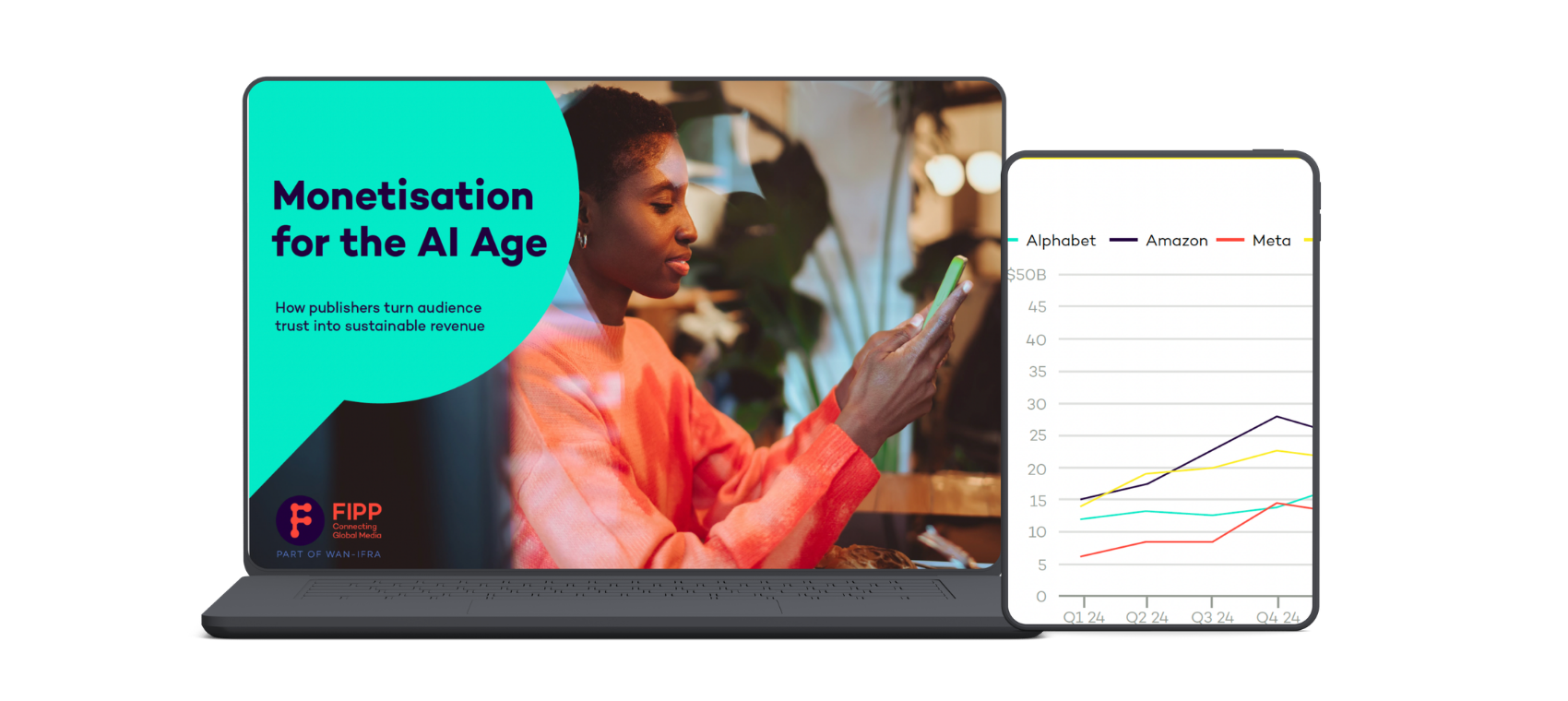
Monetisation for the AI Age: new FIPP report explores how publishers turn audience trust into sustainable revenue
After exploring the fast-changing discovery and distribution landscape, Ricky Sutton, author of The Future Media substack, turns his attention to monetisation in the AI age for the second report he has written for FIPP, exclusive to FIPP and WAN-IFRA members.
While the first report, Discovery and Distribution for the AI Age, documented the collapse of the old bargain where publishers made content, platforms sent traffic and everyone monetised the relationship, the new study looks at the arrival of the “inputs era” and puts numbers on what comes next.
With FIPP now part of WAN-IFRA membership, all FIPP resources are moving to the Knowledge Hub. This central platform also hosts a wealth of media industry presentations, recordings, expert insights, and more.
FIPP members now gain access to the full library of WAN-IFRA content across its communities, including Distripress, Women in News, AI in Media, and others. Register in the Knowledge Hub to start exploring. Scroll down for details on how to get started.
The report features case studies and insights from media industry companies leaders including The Guardian, News Corp, Sanoma, Reddit and People Inc..
“We now can’t rely on Google for discovery or Google and Meta for distribution or Google for monetisation,” Sutton points out.
“Those are the three legs of the stool our entire industry sat on for the last 15 years. So, it’s either die, or get off the stool. And if you get off the stool, then you have to build your own.”
The magnificent eight
The report starts by analysing the most recent financial filings of eight listed magazine and news publishers with footprints across the world – mapping their earnings across categories like advertising, reader revenue, AI licensing, digital listings and commerce. The results paint a varied picture.
Advertising varies from 15% of revenue at News Corp to 54% at Ziff Davis. Reader revenue is 18% at People Inc yet 70% at the New York Times.
Three of the eight earn a fifth or more of their money from digital listings. Four earn nothing from it whatsoever. Two run substantial commerce businesses, while two have none.
Ricky Sutton, author of the report, will be on the FIPP World Media Congress stage interviewing Paul Fletcher, Former Minister for Communications, Urban Infrastructure, Cities & the Arts, Australia, for a session on how publishers, platforms and politics can align. The FIPP Congress takes place from 13-15 October 2026 in Madrid, Spain. Check out the agenda and the list of speakers. Book now one of the last few available tickets.
Meanwhile, five are in active litigation against Google, OpenAI, Microsoft or Perplexity, yet not a single one has received any damages. Five are paid by AI companies, but none says how much.
The report tracks the money across seven chapters and predicts which of the categories will survive to 2030 on current trajectories, and in what order.
The findings are supported by interviews with publishers, trade bodies, the buy and sell sides of advertising, the lawyers suing the platforms, the politicians writing the laws to constrain them, and the negotiators doing the AI deals.
Getting information straight from the horse’s mouth, each were asked the same closing question: where does the money come from in 2030, and in what order?
Sutton notes that there is an illuminating throughline linking his FIPP reports: the user
“Every publisher has readers. Reaching them, satisfying them and monetising them is the thread,” he says. “Now the priority to unlock new revenues is to know them better.
“Audiences are finite, but they have many interests. The same person reading the news at breakfast, is viewing a house at lunchtime, and asking an app a question in the car on the commute home.”
Becoming a plumber
Among the case studies, the report explores how the suffering caused by platform dominance has opened a new world of opportunities at The Trade Desk.
According to Will Doherty, SVP, Inventory Partnerships Now, publishers must rebuild their brands and measure their audiences to deliver for them.
“If I’m on that publisher’s page, it’s because I know that publisher and its brand means something to me. That’s when yields go up. We’re seeing it,” he explains.
While ad ops have been deliberately marginalised over 15 years as ad sales and measurement has been outsourced, mostly to Google, they have now become a main focus in 2026.
“Ad operations is everything now. It’s how you understand your audience. It’s how you think about yield.”
Doherty likens ad ops to the publisher distribution team of the past. Knowing where your magazine sells best is the trigger for premium pricing.
Doherty believes publishers need to have “20 to 30% of their audience authenticated” to deliver “enough deterministic signal for a buyer to model the rest”.
“Below it, and the buyer is guessing and prices accordingly,” he adds. “You cannot be an exec at a media company now if you do not understand the plumbing.”
The outcome for publishers is to focus on deeper relationships with loyal readers and advertisers who matter, while cutting the apron strings with the cheap end of the market.
The newsroom that readers bought
The report also tells the extraordinary story of Le Monde, which was saved by reader revenue.
In 2010, the French newspaper was in crisis with losses running at €10 million a year. Investors recapitalise it from the brink of bankruptcy and put a magazine executive in to run it.
Fast forward 16 years and its newsroom has almost doubled, paid circulation has nearly tripled, and the economics have transformed.
According to President Louis Dreyfus, 80% of Le Monde’s revenue now comes from readers with that cash injection resulting in a €36 million turnaround to profits of €26.2 million.
Dreyfus told The Media Stack its readers had responded to the newsroom’s proud independence, turning its journalism from a cost into an asset.
“If people doubt your independence, they stop paying for the news,” he said “and
“80% of my revenue comes from readers. I cannot afford to lose their trust.”
Le Monde’s digital sub revenue in 2024 was €63 million against a newsroom costing €72 million. Dreyfus is confident subscriptions will cover the entire newsroom within two years.
The 2010 turnaround was part of a major restructure at Le Monde. The newspaper is run by a chief executive and an editorial director who cannot be appointed without 60% support from the newsroom and can’t be removed mid-term without its approval.
Employees hold a third of the supervisory board seats, and the owners cannot sell without the journalists’ consent.
The smoke and mirrors of AI licensing
While several of the world’s largest publishers are booking revenue from licensing journalism to AI, the exact numbers involved remain a mystery.
The report delves into what we do know about these deals, what publishers need to know, and how a lack of concrete figures makes the creation of a sustainable market for content impossible to set.
“Shareholders are champing at the bit to see how they are cashing in on the $720 billion being invested in winning the AI race – yet no numbers are being published,” Sutton says.
“Arguably the most strategic, fiscally-important source for growth and competitive strength for global publishing is hidden and deliberately obfuscated in their data.
The question is why?”
“Nobody yet knows what journalism is worth to an AI company. Not the publishers selling it. Not the buyers. Not the analysts modelling it. Anyone who tells you otherwise is guessing from about 20 deals, struck in private, by people who are contractually forbidden from comparing notes.”
Sutton points out that AI cannot be built without publisher content, but the two sides of the coin are reporting differently. “The buyer is reporting to the cent. The seller is hiding it. That’s not a market.”
What publisher do know is that the money to be made through AI licensing is real, with five of the eight listed publishers in the report banking it. One of the most significant AI partnerships is Reddit and Google.
Reddit and Google met each other during turbulent times. The former had gone through $750 million of investors’ money over 18 years, without banking a full year profit.
Google was also struggling having lost $100 billion in value in a day after its AI Bard flopped at its demo in 2023. The search giant urgently needed text, not the open web.
Knowing it’s worth, Reddit put a price on its access (4 cents per thousand calls) and made its data available to developers via an API, creating a self-serve marketplace.
In February 2024, Reuters reported that Google was paying Reddit $60 million a year, signalling to Wall Street that a price on AI existed. Reddit filed to go public the same day.
The date Reddit listed, its valuation ballooned to $9.5 billion, 50% above the value the market expected. OpenAI signed three months later.
The Google partnership revolutionised Reddit. It shot to the top of search listings and within weeks it was the third most visited site in the US after Google and YouTube.
But while Google’s deal with Reddit is widely established, no value has been revealed for its reported deal with The AP.
With FIPP now part of WAN-IFRA membership, all FIPP resources are moving to the Knowledge Hub. This central platform also hosts a wealth of media industry presentations, recordings, expert insights, and more.
FIPP members now gain access to the full library of WAN-IFRA content across its communities, including Distripress, Women in News, AI in Media, and others. Register in the Knowledge Hub to start exploring. Scroll down for details on how to get started.